Leaving Cuba: How Castro's State Controlled Who Could Go
For most of the Castro era, Cubans could not leave their own country without the state’s permission. Until January 2013, anyone who wanted to travel abroad needed an official exit permit, and leaving or returning without authorization was a crime (Human Rights Watch, 2005). The exit permit is gone, but the law that replaced it still allows the government to refuse passports on grounds as broad as “defence or national security” and “other reasons of public interest” — and it uses that power against critics, journalists and professionals it wants to keep (Immigration and Refugee Board of Canada; U.S. State Department).
The exit-permit state
Under the system in force for decades, the Cuban government forbade its citizens to leave or return without first obtaining official authorization, and unauthorized travel could lead to criminal prosecution. Illegal exit and illegal entry were crimes under articles 216 and 217 of the Penal Code. By Human Rights Watch’s estimate in 2005, Cuba denied exit permits to “hundreds, possibly thousands, of people every year” (Human Rights Watch, 2005).
The system bore down hardest on people the state considered valuable. “A large proportion of the Cubans denied travel permits are health care professionals,” Human Rights Watch reported; under the Public Health Ministry’s Resolution 54, a doctor applying to leave had to wait three to five years before the application would even be considered. The state also punished families: relatives of people it called “deserters” were regularly refused permission to travel, and the deserters themselves were barred from returning — a ban Human Rights Watch dated to 1999 (Human Rights Watch, 2005). Travel itself carried high government fees, and permits sometimes required bribes to corrupt officials (Human Rights Watch, 2005).
A blogger’s twenty refusals
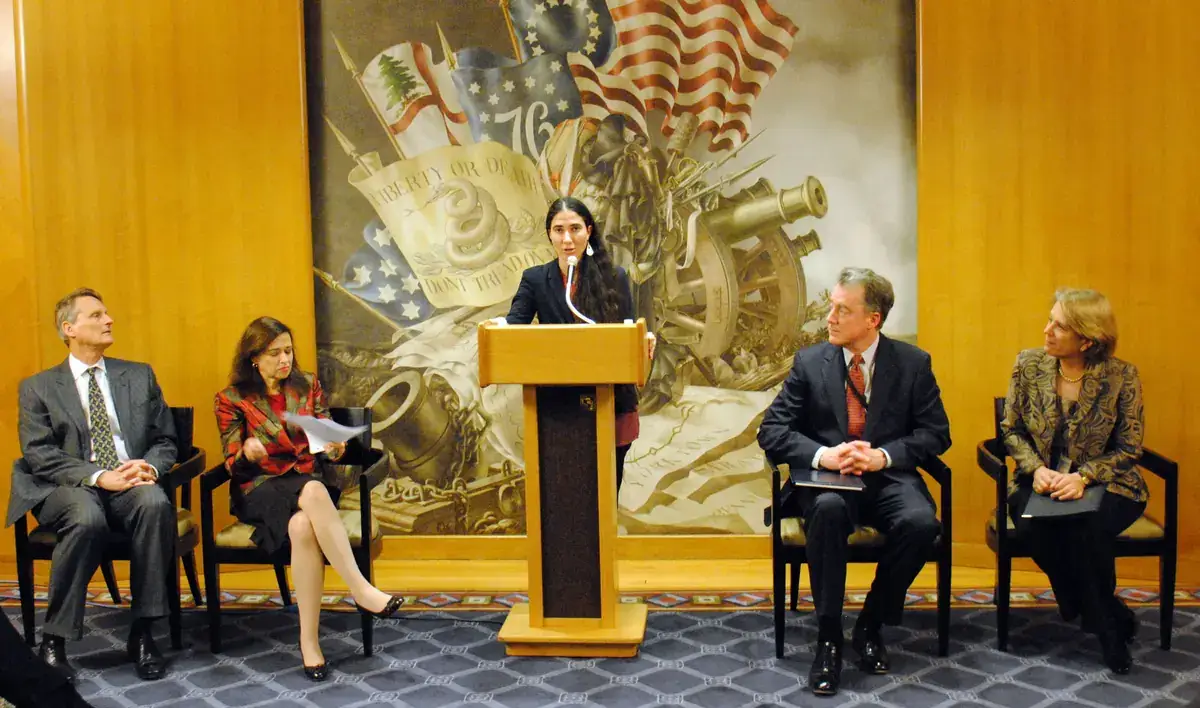
The best-known case was that of the dissident blogger Yoani Sánchez. By her count, Cuba refused her permission to travel about 20 times in the years before the system changed. On 17 February 2013, a month after the exit permit was abolished, she finally flew out of Havana’s José Martí airport, heading first to Brazil (AP). The photograph at the top of this page was taken in Washington on that trip.
The 2012 reform — and what it kept
Decree-Law 302, published in October 2012, took effect on 14 January 2013. From that date Cubans needed only a passport and any visas required by their destination. But the decree also added to the Migration Act a list of grounds on which a passport — and exit itself — could be refused. Among them, in the Canadian Immigration and Refugee Board’s translation:
- “When advisable due to defence or national security reasons”;
- “Persons lacking authorization under the rules aimed at retaining a skilled workforce”;
- “Persons with obligations to the Cuban State or civil responsibilities”;
- “Other reasons of public interest as determined by the competent authorities.”
Within weeks, former political prisoners were reported to have been refused passports on “public interest” grounds (Immigration and Refugee Board of Canada).
Travel bans today
A decade after the reform, the U.S. State Department’s 2023 human rights report on Cuba found that “the law restricted the right of citizens to leave the country” and still provided “for imprisonment, a moderate fine, or both for those who attempt to depart the country illegally.” Its findings include:
- Regulados. “The government arbitrarily designated some persons as regulados, allowing authorities to prohibit them from receiving a passport, leaving the country, or returning.” The intellectual Alina Bárbara López could not obtain a new passport because of “public interest.”
- Activists and journalists. The government barred human rights activists, religious leaders, independent journalists and artists from travelling to events abroad, and allowed some activists to leave only if they went into exile.
- Professionals. Highly specialized medical personnel, military and security personnel, many officials and academics, and many former political prisoners needed permission to emigrate. Two doctors were reported to have been stopped from boarding flights out of the country because of their medical specializations.
- Debt as a pretext. Independent media reported that at least 600 people were refused permission to leave under a 2022 rule on “significant public debts”, which the government never defined.
- Families. When former government employees emigrated, their relatives were sometimes arbitrarily denied passports to visit or join them.
Cuban doctors sent abroad on the government’s medical missions face their own rules. Human Rights Watch found in 2020 that health workers who “abandon” their posts may face criminal charges carrying up to eight years in prison, and that those who leave a mission reported a de facto eight-year ban on returning to Cuba — a ban “not clearly established in Cuban legislation” (Human Rights Watch, 2020).
Why it matters
The right to leave one’s own country is among the most basic tests of whether a state regards its citizens as free. For decades Cuba failed it openly, with an exit permit and a criminal code that punished departure. Today it fails it more quietly, through a passport law with a “public interest” clause and lists of people who may not go. What has not changed is the principle: in Cuba, whether a citizen may leave is the state’s decision.
Further reading on this site
- Cuban refugee waves — the people who left anyway, from the freedom flights to the rafters.
- The Berlin Wall and East Germany’s deadly border — another communist state that walled in its citizens.
- All articles on Cuba and on walls, borders and flight.
Sources
Primary sources
- U.S. Department of State, Bureau of Democracy, Human Rights, and Labor. Cuba 2023 Human Rights Report (Country Reports on Human Rights Practices for 2023), section 2.d. U.S. Department of State, 2024. — Regulados; doctors barred from boarding flights; exit bans for 'public debts'
Scholarship
- Human Rights Watch. Cuba/United States: Families Torn Apart. Human Rights Watch, October 2005, 2005. — The exit-permit system; illegal exit and entry as crimes (Penal Code arts. 216–217); Resolution 54 on health professionals
- Human Rights Watch. Cuba: Repressive Rules for Doctors Working Abroad. Human Rights Watch, 23 July 2020 (via ecoi.net), 2020.
Reference works
- Associated Press. Cuban dissident Yoani Sanchez on 3-month world tour after being denied exit permit for years. Fox News, 17 February 2013, 2013.
- Immigration and Refugee Board of Canada, Research Directorate. Cuba: Whether a person suspected of anti-government activities … would have been able to obtain a passport and an exit permit (2010–2013), CUB104291.E. Immigration and Refugee Board of Canada, 21 February 2013, 2013. — Decree-Law 302 (2012) and the grounds for denying passports