Joseph Stalin: A Short Biography
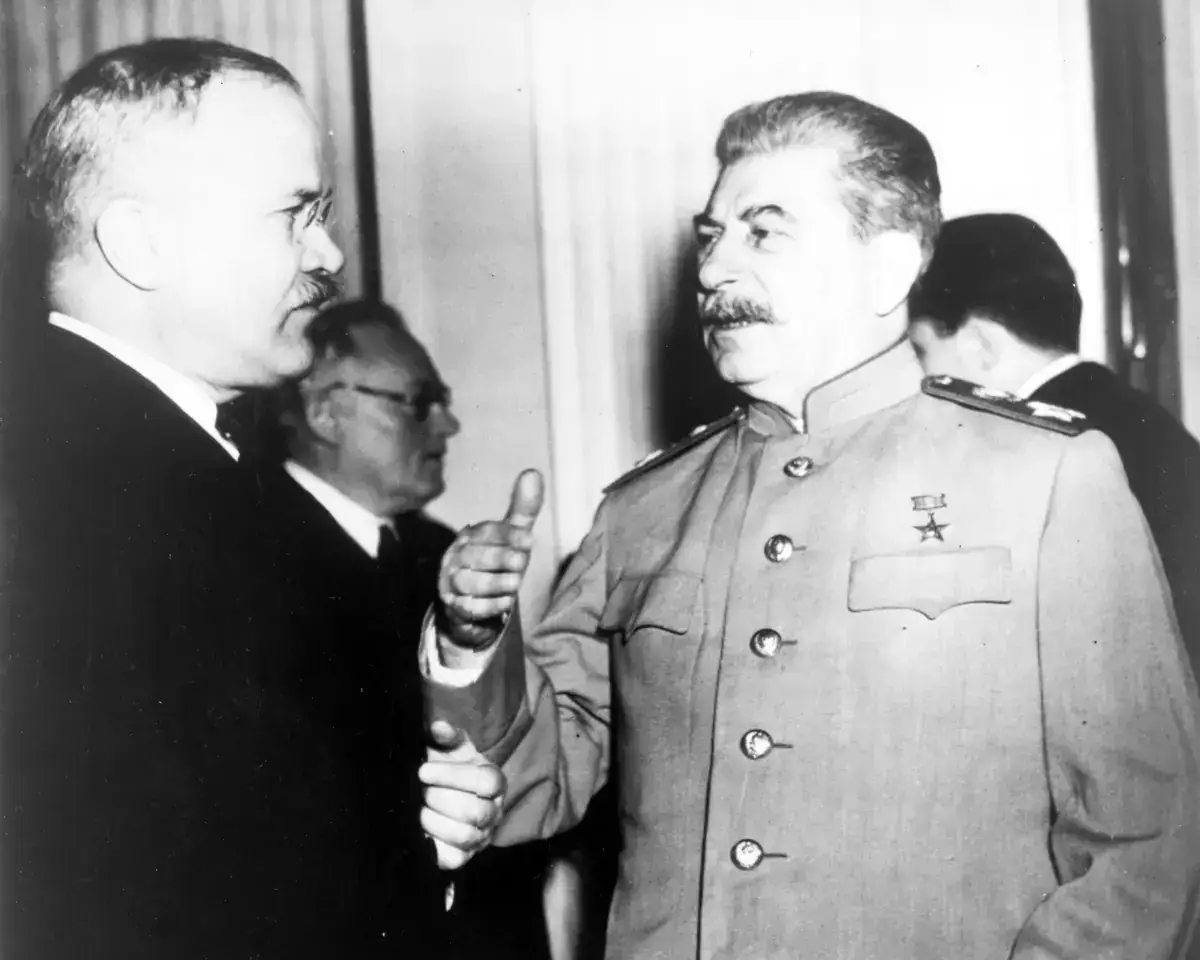
Joseph Stalin ruled the Soviet Union from the late 1920s until his death in 1953. He turned Lenin’s party-state into a personal dictatorship, forced the peasantry into collective farms at the cost of famines that killed millions, and in 1937–38 had hundreds of thousands of people shot. He is the second leader in our list of communist leaders; for the state he inherited, see our biography of Lenin.
From Gori to the Bolsheviks
Joseph Dzhugashvili was born in Gori, Georgia, on 18 December 1878 (Wikidata); some references give the year as 1879. The son of a shoemaker, he studied for the priesthood but was expelled from his theological school and joined the Social Democrats, siding with the Bolsheviks after the party split in 1903. Under the alias “Koba” he was repeatedly arrested and escaped from exile several times; in 1912 he joined the editorial staff of Pravda, and soon afterwards was exiled to Siberia again. Freed by the amnesty after the February Revolution of 1917, he became People’s Commissar for Nationalities in Lenin’s government (Encyclopedia of Marxism).
Gangster for the party
Before 1917 Stalin’s “operations, heists and killings,” writes the historian Simon Sebag Montefiore, “had made him the main financier of the Bolshevik Centre” (Montefiore, Young Stalin, prologue). Montefiore describes him as “an arsonist, killer, bank robber … [and] seducer” (Moss, Moscow Times review of Young Stalin). In the Black Sea oil port of Batumi, where he arrived in December 1901, according to a memoir Montefiore found in the Tbilisi archives, Stalin briefly worked for the Rothschilds’ oil company, then burnt down its refinery and, after organizing a strike, ordered the assassination of its director; the gunman’s pistol jammed. From 1907 in Baku, the oil boom town, his “gangster outfit of hitmen and bank robbers used protection rackets, piracy, blackmail and kidnapping” to finance Lenin (Montefiore, The Spectator).
The most notorious of these “expropriations” took place on 26 June 1907 in Yerevan Square, Tiflis. Bombs and gunfire stopped a State Bank convoy, and the gang escaped with a fortune in banknotes. According to Montefiore, Lenin had personally ordered the heist at secret meetings with Stalin in Berlin and London, even though their party had just banned expropriations (Montefiore, prologue). Estimates of the haul range from about 241,000 to 341,000 roubles, and of the dead from six to about forty, the higher figure from police archives (Milton, Aspects of History; Wikipedia). Stalin’s exact role remains disputed: some witnesses placed him at the scene, while Trotsky wrote that “others did the fighting; Stalin supervised them from afar” (Wikipedia).
Exile and illegitimate children
In exile Stalin left children behind. In 1911 he lodged with a young widow, Maria Kuzakova, who became pregnant; when his term ended in 1912 he left before the birth of their son, Konstantin (RBTH).
During his Siberian exile of 1914–1916, Stalin — then in his mid-thirties — began a sexual relationship with Lidia Pereprygina, a peasant girl in the household where he lodged. She was 13 according to Montefiore’s account and 14 according to other sources (Moss; RBTH). She bore him two children: the first died, and the second, Alexander, was born in April 1917 and registered under Stalin’s real surname, Dzhugashvili. The villagers accused Stalin of seducing a minor, and he promised to marry her — but left as soon as his exile ended. Both Kuzakova and Pereprygina later wrote to Stalin asking for help and received no answer; in the 1930s they were made to sign undertakings never to reveal who had fathered their children (RBTH).
Winning the succession
In 1922 Stalin was appointed General Secretary of the party — a post that then seemed administrative rather than powerful. In notes dictated that winter, Lenin warned that Stalin “has unlimited authority concentrated in his hands” and urged the party to remove him: “Stalin is too rude” (Lenin, Letter to the Congress). By the time the notes were read to the Central Committee in May 1924, Stalin had allied with Grigorii Zinoviev and Lev Kamenev against Leon Trotsky and the issue was sidetracked. Using his control of party appointments, Stalin then defeated Trotsky, turned on Zinoviev and Kamenev in 1926, and in 1928 attacked his last major rival, Nikolai Bukharin (Seventeen Moments).
Collectivization and famine
On 27 December 1929 Stalin announced that the party had passed “from the policy of restricting the exploiting tendencies of the kulaks to the policy of eliminating the kulaks as a class” (Stalin, 1929). Peasants were driven into collective farms; those labelled kulaks were dispossessed and resettled, deported, sent to labour camps or, in the “most dangerous” cases, executed (Seventeen Moments).
The result was catastrophe. Historians who have worked in the Soviet archives agree that the famines of 1931–33 “were not the result of poor weather conditions but directly caused by regime policies.” Between 4 and 4.5 million people died in Ukraine and the Kuban, and between 1.1 and 1.4 million in Kazakhstan — while the government exported 1.8 million tons of grain (Werth, Sciences Po). See the Holodomor and Soviet forced population transfers.
The Great Terror
The murder of the Leningrad party chief Sergei Kirov in December 1934 was followed by arrests of Stalin’s former rivals; between 1936 and 1938 Zinoviev, Kamenev, Bukharin and others were convicted in staged show trials and shot (Seventeen Moments). On 3 July 1937 the Politburo ordered “mass operations” against “anti-Soviet elements,” with arrest quotas for each district; the projected totals of 177,500 exiled and 72,950 executed “were eventually exceeded” (Seventeen Moments).
Within sixteen months of August 1937 more than 1.5 million people were arrested, and about 800,000 were sentenced to death. These “secret mass repression operations,” the historian Nicolas Werth concludes, “were decided and planned by Stalin in person”; the purges of political, military and intellectual elites accounted for only 40,000 to 50,000 of those executed (Werth).
The cult
By the end of the 1930s the cult of Stalin was in full swing. At his behest historians rewrote the history of the party to make him a central figure in the underground, the revolution and the civil war — a “gross distortion of historical fact.” The resulting Short Course of the History of the Communist Party, published in October 1938, became a basic text of Stalinism and sold forty million copies around the world (Seventeen Moments).
War and conquest
On 23 August 1939 Stalin signed a non-aggression pact with Hitler whose secret protocol divided Poland between them; the Red Army invaded eastern Poland on 17 September. In 1940 the Baltic states were annexed (Seventeen Moments). In 1940 the NKVD shot about 20,000 Polish prisoners — 4,443 of them at Katyn. Stalin denounced the German discovery of the graves as a “monstrous invention,” and the Soviet Union denied responsibility until Gorbachev admitted that Stalin had ordered the executions (Seventeen Moments).
During the war against Germany, Stalin’s regime punished whole nations. In 1943–44 about one million Chechens, Ingush, Karachai, Balkars, Kalmyks, Meskhetian Turks and Crimean Tatars were deported to Kazakhstan and Central Asia, collectively charged with treason (Seventeen Moments).
The last years
Victory brought no relief. In the famine of 1946–47 grain procurement quotas stayed high and a decree ordered the return of all collective-farm land used for private plots (Seventeen Moments). Stalin died at his dacha at Kuntsevo on 5 March 1953 (Wikidata).
A partial reckoning
On 24 February 1956 Nikita Khrushchev denounced Stalin in a closed session of the Twentieth Party Congress, detailing the execution of loyal party members, wartime blunders and the deportation of nationalities, and blaming the “cult of personality.” The speech said nothing about the violence and famine of collectivization, or about the responsibility of other party leaders — Khrushchev included (Seventeen Moments).
Why it matters
Stalin is often treated as a deviation from communism. But the instruments he used — the one-party state, the secret police, terror against “class enemies” — were Lenin’s, and the policy that killed the most people, the war on the peasantry, was carried out in the name of building socialism. The party that later condemned his “cult of personality” kept the system that had made it possible.
Further reading on this site
- Vladimir Lenin: a short biography — the state Stalin inherited.
- The Holodomor and Soviet forced population transfers.
- Repression under communism — the Soviet record alongside China, Cambodia and North Korea.
- Communist leaders: a reference list.
Sources
Primary sources
- Lenin, V. I. Letter to the Congress (23 December 1922 – 4 January 1923). Marxists Internet Archive, 1922.
- Stalin, J. V. Concerning Questions of Agrarian Policy in the U.S.S.R. (speech, 27 December 1929). Works, vol. 12 (Moscow, 1954), Marxists Internet Archive, 1929.
Scholarship
- Milton, Giles. When Stalin Robbed A Bank. Aspects of History (from Fascinating Footnotes, John Murray).
- Montefiore, Simon Sebag. Young Stalin (prologue: The Bank Robbery). Knopf, 2007 (excerpt at BookBrowse), 2007.
- Montefiore, Simon Sebag. Diary – 19 May 2007 (Stalin and the Rothschilds; Batumi and Baku). The Spectator, 19 May 2007, 2007.
- Moss, Walter G. Becoming Stalin (review of Young Stalin). The Moscow Times, 19 October 2007, 2007.
- Russia Beyond (RBTH). Stalin's women: Who shared a bed with the Soviet leader? RBTH.
- Siegelbaum, Lewis; von Geldern, James. Seventeen Moments in Soviet History: subject essays on Lenin's Succession, Collectivization, the Kirov Affair, the Great Terror, the Cult of Personality, Soviet Territorial Annexations, the Katyn Forest Massacre, the Deportation of Minorities, the Famine of 1946–1947 and Khrushchev's Secret Speech. Seventeen Moments in Soviet History (University of Illinois).
- Werth, Nicolas. Mass Crimes under Stalin (1930–1953). Mass Violence & Résistance, Sciences Po, 14 March 2008, 2008.
Reference works
- Encyclopedia of Marxism. Stalin, Joseph (glossary entry). Marxists Internet Archive. — Early life and revolutionary career (used for facts only)
- Wikidata. Joseph Stalin (Q855). Wikimedia Foundation. — Dates and places of birth and death
- Wikipedia. 1907 Tiflis bank robbery. Wikimedia Foundation. — Summary of the casualty and haul estimates and of the debate over Stalin's role