Turkmenistan: How a Soviet Party Boss Became Turkmenbashi
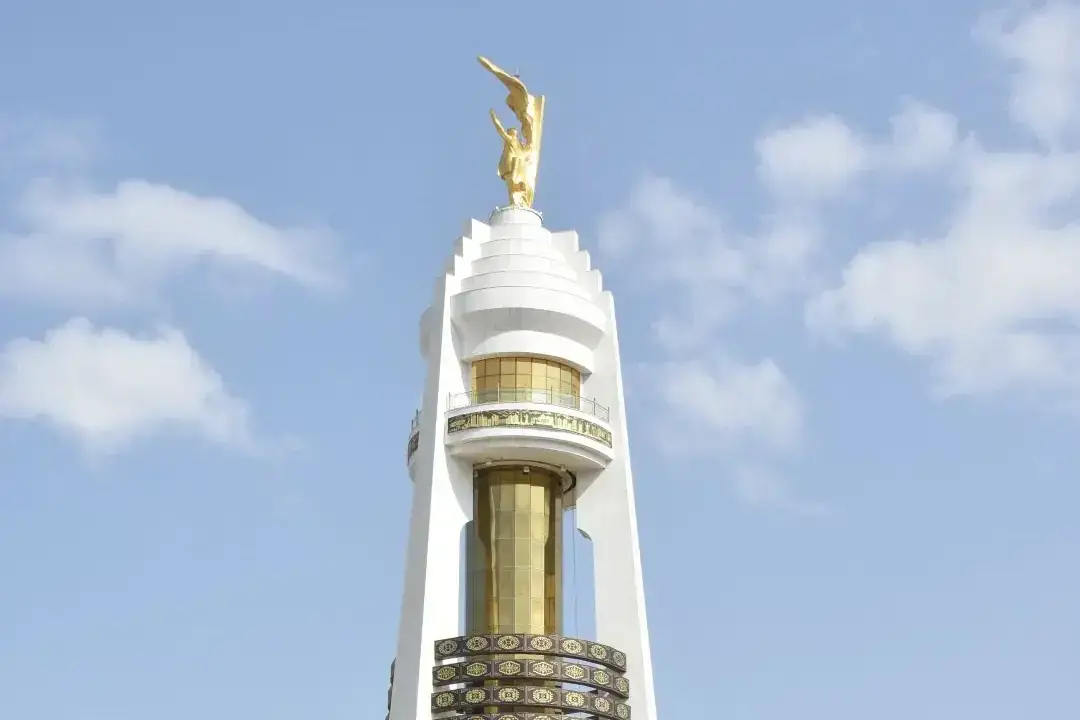
Turkmenistan is one of the least free countries on earth. Freedom House gives it a score of 1 out of 100: political rights and civil liberties “are almost completely denied in practice” (Freedom House, 2025). Its dictatorship is not a break with the communist past but a continuation of it — built by the man who ran the Soviet Communist Party in Turkmenistan when the Soviet Union collapsed.
The party boss
In 1985 Saparmurat Niyazov, after a spell in Moscow as an instructor at the Central Committee of the Communist Party, became chairman of the Turkmen Soviet republic’s Council of Ministers and first secretary of the Turkmen Communist Party. When hard-liners attempted a coup against Mikhail Gorbachev in 1991, Niyazov supported them. On 27 October 1991 Turkmenistan declared independence — with Niyazov still in charge (Kimmage, RFE/RL).
He won an uncontested presidential vote in 1992, the last to be held in his lifetime. In 1993 he took the title Turkmenbashi, “head of all the Turkmen,” and in 1999 the legislature proclaimed him president for life (Kimmage).
Turkmenbashi
Niyazov built an extravagant personality cult. The months of the year were renamed to honour him and his family, and monuments to himself were erected, among them a gold-plated statue in central Ashgabat (Kimmage). His book, the Ruhnama, written in 2001, became a compulsory part of the curriculum at every level of education and was required reading even to pass a driving test (RFE/RL, 2013; Kimmage).
Behind the cult stood the security services, which Niyazov used to eliminate dissent and every possible rival. After an apparent assassination attempt in 2002 he launched purges and show trials; his former deputy prime minister Boris Shikhmuradov made a televised confession and was sentenced to 25 years (Kimmage).
From father to son
Niyazov died in December 2006. His successor, Gurbanguly Berdimuhamedov, reportedly dropped the Ruhnama from the school curriculum (RFE/RL, 2013) but “created a cult of personality around himself.” In March 2022 his son Serdar Berdimuhamedov won a snap presidential election with a reported 73 percent of the vote, while the father remained chair of the upper house of parliament. No election in Turkmenistan has been judged free and fair by OSCE observers since independence (Blackwood, CRS).
A closed country
Human Rights Watch reports that “there is no media freedom in Turkmenistan.” More than 122,000 internet domains are blocked, and the authorities pursue users and providers of VPNs. Arbitrary bans on foreign travel continue, and people are barred from boarding international flights without explanation. Registered religious groups are closely monitored and unregistered congregations forbidden. Human rights groups count 96 continuing enforced disappearances of prisoners, including at least 33 people whose prison terms have ended but whose fate remains unknown (Human Rights Watch, 2025). Freedom House adds that passports are confiscated to restrict movement and that schoolchildren and public employees are still forced to pick cotton (Freedom House).
Why it matters
The collapse of the Soviet Union did not bring freedom everywhere. In Turkmenistan, the man who had run the republic’s Communist Party kept power through independence and used the security services to build a personal dictatorship. The ideology changed; the machinery of control did not. Turkmenistan shows how long the institutions of a communist state can outlive communism itself.
Further reading
- On this site: North Korea’s information blockade — another state that shuts its people off from the world.
- Luca Anceschi, “Turkmenistan’s Foreign Policy: Positive Neutrality and the Consolidation of the Turkmen Regime”
Sources
Primary sources
Scholarship
- Human Rights Watch. World Report 2025: Turkmenistan. Human Rights Watch, 2025.
- Kimmage, Daniel. Turkmenistan: Looking Back On Niyazov's Legacy. Radio Free Europe/Radio Liberty, 21 December 2006, 2006.
- Radio Free Europe/Radio Liberty. Turkmenistan's Rukhnama: The Final Chapter? RFE/RL, 13 August 2013, 2013.