Nikita Khrushchev: A Short Biography
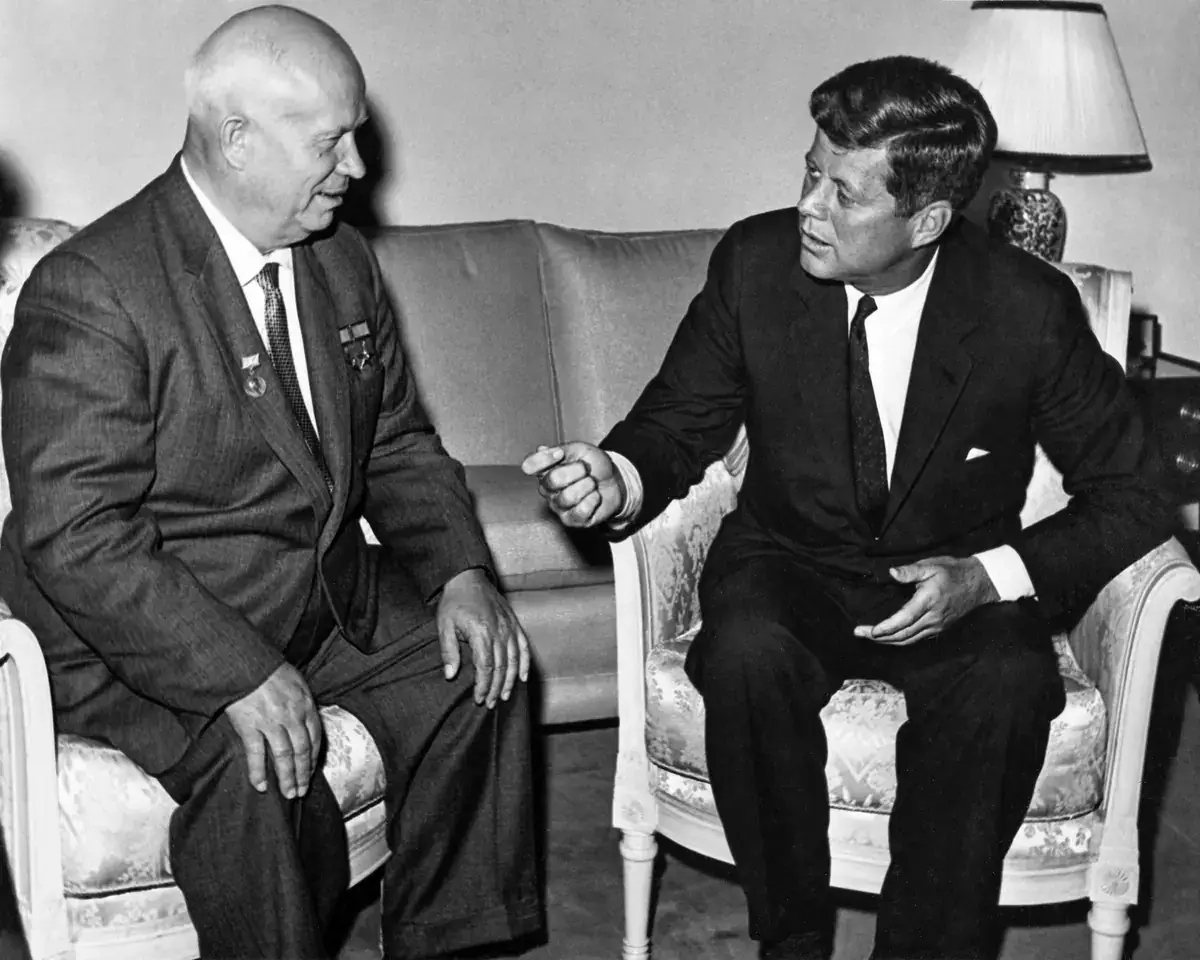
Nikita Sergeyevich Khrushchev (1894–1971) led the Soviet Union from Stalin’s death until 1964. In February 1956 he told a closed session of the party congress that Stalin had had loyal communists tortured and shot, and the release and rehabilitation of political prisoners gathered pace. In November of the same year he sent the Red Army to crush the Hungarian revolution. Both acts are documented, and neither cancels the other. Khrushchev had risen through Stalin’s Terror and helped carry it out. When he dismantled parts of Stalinism, he kept its core: the party’s monopoly on power and its readiness to use force to keep it.
From the Donbas to Stalin’s inner circle
Khrushchev was born in 1894 in Kalinovka, a poor village in southern Russia. In 1908 his family moved to Yuzovka, a mining and industrial town in the Donbas, where he became a skilled metalworker. He joined the Bolsheviks in 1918 and served as a political commissar in the Red Army during the Civil War, then held party posts in the Donbas and Ukraine. In 1929 he enrolled at the Industrial Academy in Moscow (Taubman; Encyclopedia of World Biography).
From there he rose fast. He became second secretary of the Moscow city party in 1932 and took over Moscow province in 1935. His close ties to Lazar Kaganovich, Stalin’s lieutenant, and his earlier friendship with Stalin’s wife helped him survive the purges that destroyed many of his colleagues (Taubman).
His part in the Terror
Khrushchev’s biographer William Taubman calls him “complicit in the Great Terror that Stalin unleashed” (Taubman). The archives show what that meant in practice.
In early July 1937 the Politburo ordered regional party and secret police chiefs to register returned “kulaks and criminals” so that the most hostile among them could be shot by three-man tribunals (troikas), and to report how many fell into the “first category” (execution) and the “second category” (camps or prisons). On 10 July Khrushchev, as Moscow party leader, informed Stalin that 41,305 people had been registered in Moscow province: 8,500 in the first category and 32,805 in the second (Jansen and Petrov, pp. 82–83). These were proposed quotas, not final death tolls; across the country such quotas were soon raised many times over. Khrushchev was also among the senior leaders, with Molotov, Kaganovich, Zhdanov, Malenkov and others, who travelled to the provinces in 1937 to speed up the purge of local party and state officials (Jansen and Petrov, pp. 100–101).
In 1938 Stalin sent him to run Ukraine, where Taubman describes him as “Stalin’s viceroy.” After the 1939 Nazi-Soviet pact he oversaw the annexation of Polish-ruled western Ukraine. During the war he was a political commissar at Stalingrad and Kursk, and shared responsibility for the disasters at Kiev and Kharkov. Back in Ukraine after the war, he tried to obtain aid from Moscow when Stalinist policies led to famine in 1946, and he was, in Taubman’s words, “the driving force” in a brutal war against the Ukrainian independence movement in the west of the republic. In 1949 he returned to Moscow (Taubman).
Winning the succession
Stalin died on 5 March 1953. Within weeks a decree of 27 March amnestied prisoners serving sentences of up to five years and certain other groups, and over 1.5 million people were released within three months (Seventeen Moments). In June Khrushchev led the conspiracy against Lavrentii Beria, the secret police chief, who was arrested and later executed (Taubman; Seventeen Moments). In September 1953 Khrushchev became First Secretary of the Central Committee (Encyclopedia of World Biography), and by 1955 he had demoted his main rivals, Georgii Malenkov and Viacheslav Molotov (Taubman).
The Secret Speech, February 1956
On the night of 24–25 February 1956, at a closed session of the Twentieth Party Congress, Khrushchev spoke for more than four hours on “the cult of personality and its consequences” (Jones; Khrushchev, 1956). It was “secret” because it was not published in the congress record or the Soviet press; it was read out to party members across the country, and a copy obtained by the U.S. State Department was published in the West (Seventeen Moments). It was not printed in the Soviet Union until 1989, and no recording or transcript of what was actually said has been found (Jones).
The speech gave the delegates figures that many had never heard:
| What Khrushchev reported | Figure |
|---|---|
| Members and candidates of the Central Committee elected at the 17th Congress (1934) | 139 |
| …of whom “arrested and shot (mostly in 1937–1938)” | 98 (70%) |
| Delegates to the 17th Congress | 1,966 |
| …of whom “arrested on charges of anti-revolutionary crimes” | 1,108 |
He also described the use of torture against prisoners and the deportation of whole nations — Karachai, Kalmyks, Chechens, Ingush, Balkars — adding that the Ukrainians “avoided meeting this fate only because there were too many of them” (Khrushchev, 1956; see also Stalin’s deportations).
The speech was also carefully limited. It blamed the crimes on Stalin’s “cult of personality” and “violations of socialist legality,” not on the party or the system. It said nothing about the violence and famine of collectivization — including the Holodomor in Ukraine — nor about the repression of intellectuals, and it did not suggest that other leaders, Khrushchev among them, shared responsibility (Seventeen Moments). Its victims were above all party members; the far larger numbers of ordinary citizens shot under quotas like the ones Khrushchev had submitted in 1937 were left out. (For Stalin’s record as a whole, see our biography of Stalin.)
The Thaw and its limits
The speech accelerated the release of political prisoners. A commission set up in 1954 had freed several thousand; rehabilitation intensified only after February 1956 (Seventeen Moments). In 1962 Khrushchev and Anastas Mikoyan approved the publication of Aleksandr Solzhenitsyn’s labor-camp story One Day in the Life of Ivan Denisovich, which appeared in the journal Novyi Mir that November (Sabbatini).
The Thaw had firm limits. In December 1962, touring an exhibition at the Moscow Manege, Khrushchev berated abstract artists, including the sculptor Ernst Neizvestny (Seventeen Moments; Kishkovsky). From the late 1950s a renewed campaign against religion closed about ten thousand churches and four of the eight Orthodox seminaries (Seventeen Moments). And on 2 June 1962, when workers in Novocherkassk marched on the party headquarters to protest nationwide increases in meat and dairy prices, the crowd was dispersed by gunfire. Twenty-four people died; 114 were later convicted and seven executed, and the authorities tried to cover up what had happened (Seventeen Moments).
Hungary, 1956
The Secret Speech shook the communist world. Workers protested in Poznań, Poland, in June 1956, and that autumn upheaval in Poland was followed by revolution in Hungary (Seventeen Moments; Taubman).
On 23 October 1956 student demonstrations in Budapest turned into a national uprising (Böll Foundation; National Security Archive). Soviet troops already in the country entered the fighting but could not suppress it. Imre Nagy, a reform communist reappointed prime minister on 24 October, brought non-communists into the government and moved toward the insurgents’ demands, including an end to one-party rule (Seventeen Moments; Seventeen Moments). On 31 October Pravda published a Soviet declaration offering to negotiate the presence of Soviet troops in Hungary (National Security Archive).
That same day, Khrushchev told the Presidium in Moscow that Soviet troops should not be withdrawn from Hungary after all. The working notes of the meeting record him saying that departure would boost “the imperialists,” who “will perceive it as weakness on our part and will go onto the offensive,” and concluding: “We have no other choice.”
The Presidium agreed. Marshal Zhukov was instructed to draw up a military plan, and a new “Provisional Revolutionary Government” was planned, with János Kádár among the candidates to lead it (Presidium notes, 31 October 1956). The reference to Egypt was to the British, French and Israeli attack on Suez, which had begun on 29 October (National Security Archive).
The order of events matters, because the invasion is sometimes explained as a response to Hungary leaving the Warsaw Pact. The decision came first. On 1 November, after its army reported that large Soviet forces had crossed the eastern border and were heading for Budapest, the Nagy cabinet declared Hungary neutral, renounced the Warsaw Pact and appealed to the United Nations (Nagy cabinet minutes, 1 November 1956).
At 4:15 a.m. on 4 November Soviet forces launched their attack (National Security Archive). Kádár announced a new government under his leadership. Nagy took refuge in the Yugoslav embassy, left it on 22 November under a promise of safe passage, and was immediately arrested by Soviet security officers. He was tried in secret and executed in June 1958 (Seventeen Moments; National Security Archive).
| The cost of the revolution (estimates) | Figure |
|---|---|
| Hungarian insurgents killed | about 2,500 |
| Soviet soldiers killed | about 700 |
| Wounded | about 20,000 Hungarians, 1,500 Soviet soldiers |
| People who fled Hungary | about 200,000 |
| Convicted by Kádár’s courts | 22,000 (13,000 imprisoned) |
| Executed | at least 200 |
Sources: Böll Foundation (all rows); Seventeen Moments also gives “as many as 200,000” refugees. Casualty counts are estimates and vary between studies.
For the other uprisings of the period, see our Eastern Europe hub.
Premier, Berlin and Cuba
In June 1957 Molotov, Kaganovich and other Stalinist veterans tried to remove Khrushchev at a Presidium meeting. He appealed to the full Central Committee, whose members Defense Minister Zhukov helped fly to Moscow, and the majority condemned his opponents as an “anti-Party group.” They were not shot, as losers of Stalin-era power struggles had been; they were expelled from the Presidium and given minor posts (Seventeen Moments). In 1958 Khrushchev also became chairman of the Council of Ministers (Encyclopedia of World Biography).
His policies abroad were as erratic as at home. In November 1958 he issued an ultimatum meant to force the West to recognize East Germany; when that failed, he had to settle for the Berlin Wall, built in August 1961. He placed nuclear missiles in Cuba in 1962 to offset American strategic superiority, and was forced to remove them. His demands on Mao and his withdrawal of Soviet experts from China in 1960 opened the Sino-Soviet split. At home, his crash program to farm the “Virgin Lands” of Kazakhstan and Siberia, launched in 1954, was in Taubman’s words “ill-conceived” (Taubman).
Fall and retirement
In October 1964, while Khrushchev was away from Moscow, his colleagues led by Leonid Brezhnev confronted him with a united Presidium and Central Committee and forced him to resign, officially on grounds of age and health (Taubman; Encyclopedia of World Biography). The U.S. ambassador in Moscow reported that the Central Committee vote was “a perfunctory rubberstamp of a Presidium decision” (Kohler, 18 October 1964).
He spent his last years under de facto house arrest outside Moscow, dictating memoirs — the first by a Soviet leader — which were published in the West as Khrushchev Remembers (1970) (Taubman). He died on 11 September 1971 (Encyclopedia of World Biography). His family asked Ernst Neizvestny, the sculptor he had berated in 1962, to design his tombstone at Novodevichy Cemetery; it sets his head between slabs of black and white marble (Kishkovsky).
Reformer or Stalinist?
Taubman judges Khrushchev’s legacy “remarkably mixed.” His de-Stalinization, “awkward and erratic” as it was, prepared the ground for Mikhail Gorbachev’s reforms a generation later, and his motives in 1956, Taubman argues, ranged “from compromising Stalinist colleagues to expiating his own sins” (Taubman). Both halves of that judgment are supported by the documents. The speech exposed the killing of party members in figures no Soviet leader had admitted before, and the release of prisoners was real. But the same documents show its limits: the speech blamed one man, not the system; it was silent about the peasants who died in collectivization and about Khrushchev’s own lists of 1937.
Hungary shows where the line ran. When reform threatened the party’s monopoly and the Soviet bloc, Khrushchev did not hesitate: on 31 October 1956 his concern, recorded in his own words, was that withdrawal would be seen as weakness. After Beria, Soviet leaders stopped shooting their defeated rivals, and many of Stalin’s prisoners came home; but the Soviet Union remained a one-party state that answered strikes, as at Novocherkassk, and revolutions, as in Budapest, with force. His successors kept that order for another quarter-century.
Further reading on this site
- Joseph Stalin: a short biography and Vladimir Lenin: a short biography.
- Communist leaders: a reference list — Khrushchev’s predecessors and successors.
- Stalin’s deportations — the deported nations named in the Secret Speech.
- The Berlin Wall and East Germany’s deadly border.
- Repression under communism and our timeline.
Sources
Primary sources
- Khrushchev, N. S. Speech to the 20th Congress of the C.P.S.U. ("On the Cult of Personality and Its Consequences"), 24–25 February 1956. Marxists Internet Archive, 1956. — Figures on the 17th Congress Central Committee and delegates; the deportation of nations
- Kohler, Foy D. Telegram From the Embassy in the Soviet Union to the Department of State, Moscow, October 18, 1964. Foreign Relations of the United States, 1964–1968, Volume XIV, Soviet Union, Document 60 (Office of the Historian), 1964.
- Malin, V. N. (notes). Working Notes and Attached Extract from the Minutes of the CPSU CC Presidium Meeting, October 31, 1956 (Document No. 6). National Security Archive, from Csaba Békés, Malcolm Byrne and János M. Rainer, eds., The 1956 Hungarian Revolution: A History in Documents (Central European University Press, 2002), 1956. — Khrushchev's arguments for crushing the revolution
- Minutes of the Nagy Government's Fourth Cabinet Meeting, November 1, 1956 (Document No. 7). National Security Archive, from Békés, Byrne and Rainer, eds., The 1956 Hungarian Revolution: A History in Documents (CEU Press, 2002), 1956. — Hungary renounces the Warsaw Pact after Soviet troops cross the border
Scholarship
- Byrne, Malcolm (ed.). The 1956 Hungarian Revolution (Electronic Briefing Book No. 76). National Security Archive, George Washington University, 2002.
- Jansen, Marc; Petrov, Nikita. Stalin's Loyal Executioner: People's Commissar Nikolai Ezhov, 1895–1940 (chapter 4, The Great Terror). Hoover Institution Press, 2002, pp. 82–83, 100–103. — Khrushchev's July 1937 report of 41,305 people registered for repression in Moscow province
- Jones, Polly. 70 Years After the Secret Speech, Russia Is Still Reckoning With Stalin. The Moscow Times, 25 February 2026, 2026.
- Kishkovsky, Sophia. Ernst Neizvestny — sculptor who stood up to Khrushchev's criticism — has died, aged 91. The Art Newspaper, 10 August 2016, 2016.
- Sabbatini, Marco. One Day in the Life of Ivan Denisovich. Voci libere in URSS (Firenze University Press).
- Siegelbaum, Lewis; von Geldern, James. Seventeen Moments in Soviet History: subject essays on Khrushchev's Secret Speech, the Hungarian Crisis, the Anti-Party Group, Prisoners Return, the Novocherkassk Massacre, the Fight Against Superstition and Khrushchev on the Arts. Seventeen Moments in Soviet History (University of Illinois).
- van de Rakt, Eva; Schultheis, Silja; Szombati, Kristóf. Introduction: The 1956 Hungarian uprising. Heinrich-Böll-Stiftung, 21 October 2016, 2016. — Casualties, convictions, executions and refugees
Reference works
- Khrushchev, Nikita Sergeyevich (Encyclopedia of World Biography entry). Gale, via Encyclopedia.com. — Party membership 1918, First Secretary 1953, premier 1958, death on 11 September 1971
- Taubman, William. Khrushchev, Nikita Sergeyevich. Encyclopedia of Russian History (Macmillan Reference USA), via Encyclopedia.com, 2004. — Career outline and assessment by the author of Khrushchev: The Man and His Era (Norton, 2003)