Vladimir Lenin: A Short Biography
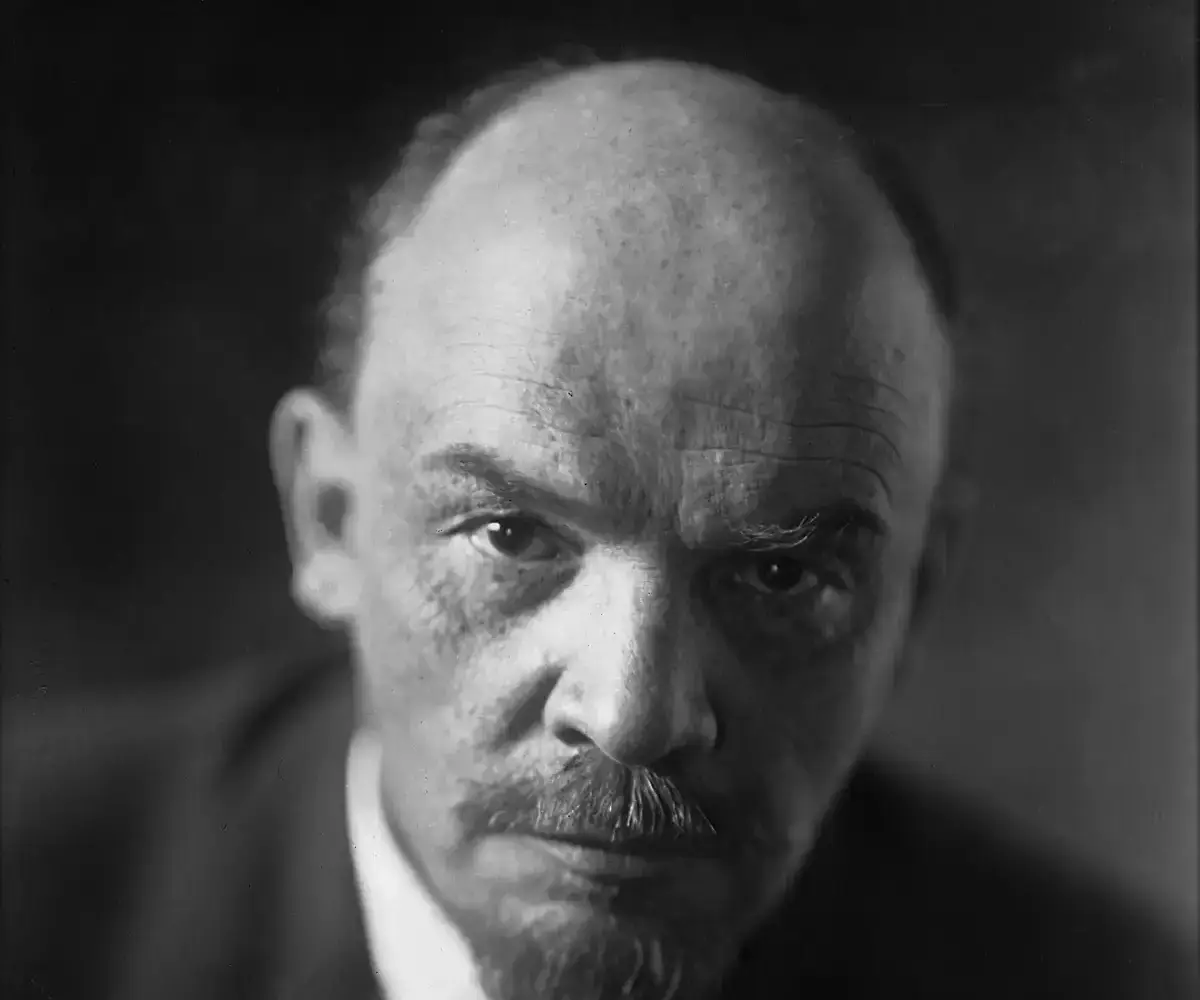
Vladimir Ilyich Lenin (1870–1924) founded the Bolshevik party, led its seizure of power in Russia in October 1917, and built the first communist state. He is sometimes remembered as an idealist whose revolution was betrayed by Stalin. His own writings and orders show something else: the one-party state, the secret police and the use of terror against whole social groups were all in place, and defended by Lenin, while he was alive. (For the leaders who followed him, see our list of communist leaders.)
A revolutionary from youth
Lenin was born in April 1870. His elder brother was hanged for taking part in a plot to assassinate Tsar Alexander III. Lenin qualified in law in 1891, joined Marxist circles in St. Petersburg, and was arrested in December 1895. After prison he was exiled to the village of Shushenskoye in Siberia; when his term ended he emigrated and founded the newspaper Iskra abroad. From 1903 he was one of the leaders of the Bolshevik faction of the Russian Social Democratic Labour Party (Encyclopedia of Marxism).
The vanguard party
Lenin’s most influential idea was set out in What Is to Be Done?, written in 1901–1902. He called for a centralized, all-Russia organization that would “consist of professional revolutionaries and be led by the real political leaders of the entire people” (Lenin, What Is to Be Done?). The idea of a small, disciplined vanguard leading the masses would shape the communist parties that followed.
1917: taking power
When the tsar fell in February 1917, Lenin was in Switzerland. He reached Petrograd on 3 April aboard a sealed train that had taken him through Germany, and immediately demanded “all power to the soviets” (Seventeen Moments). In September, in hiding in Finland, he urged his party’s Central Committee that the Bolsheviks “can and must take state power into their own hands.” In October they did so, and Lenin became head of the new Soviet government (Seventeen Moments).
Building the dictatorship
Within weeks the new government created its instrument of repression. On 7 December 1917 (Old Style) a decree established the All-Russian Extraordinary Commission for Combating Counter-Revolution and Sabotage — the Cheka — under Feliks Dzerzhinsky. It was the forerunner of the GPU, the NKVD and the KGB (Seventeen Moments).
Russia had meanwhile held its first free national election, for a Constituent Assembly. By Lenin’s own count, the Bolsheviks won 9,023,963 of 36,262,560 votes — about a quarter — while Socialist Revolutionaries of all nationalities together won 58 percent (Lenin, 1919). Lenin had made clear in advance that the Bolsheviks would not be bound by the result. The Assembly met for a single session on 5 January 1918; Red Guards prevented it from meeting again (Seventeen Moments).
Terror
In August 1918, facing a peasant revolt in Penza province, Lenin telegraphed local communists: “You need to hang (hang without fail, so that the people see) no fewer than 100 of the notorious kulaks, the rich and the bloodsuckers.” The killing was to be done “in such a way that the people for hundreds of versts around will see, tremble” (Lenin, 11 August 1918).
On 5 September 1918 Lenin’s government formally adopted terror. Its resolution declared that “the safeguarding of the rear by means of terror is necessary,” that class enemies should be isolated “in concentration camps,” and that “all persons associated with White Guard organizations, plots and rebellions are liable to be shot” (Resolution on Red Terror). Official figures recorded 6,300 executions by the Cheka in twenty provinces in 1918 alone — figures the historians of Seventeen Moments in Soviet History call “probably an understatement” (Seventeen Moments).
Famine, rebellion and retreat
Years of forced grain requisitioning had shrunk the sown area, leaving little margin for a bad harvest. When the Volga crops failed in 1921, the famine affected at least twenty million people (Seventeen Moments). In March 1921 the sailors of the Kronstadt naval base — once important allies of the Bolsheviks — rose up, demanding freedom of speech and assembly and an end to the Bolshevik monopoly on power. The regime branded them White puppets and sent about 45,000 troops across the ice to crush them (Seventeen Moments). The same month, Lenin retreated on the economy with the New Economic Policy, which let peasants sell their surplus after paying a tax in kind (Seventeen Moments). Political freedom was not part of the retreat.
The famine itself became a weapon. On 19 March 1922, in a top-secret letter to the Politburo, Lenin argued that “now and only now, when people are being eaten in famine-stricken areas,” the regime could seize church valuables “with the most frenzied and ruthless energy.” He added: “The greater the number of representatives of the reactionary clergy and the reactionary bourgeoisie that we succeed in shooting on this occasion, the better” (Lenin to Molotov, 1922).
Illness and death
A series of strokes in 1922 ended Lenin’s active role in government. In dictated notes of December 1922, he warned that Stalin, as General Secretary, “has unlimited authority concentrated in his hands,” and on 4 January 1923 he added: “Stalin is too rude… I suggest that the comrades think about a way of removing Stalin from that post” (Lenin, Letter to the Congress).
Lenin died on 21 January 1924, not quite fifty-four. Against his own wishes and those of his family, the Politburo had his body embalmed and displayed in a mausoleum on Red Square, and Petrograd was renamed Leningrad (Seventeen Moments).
Why it matters
Lenin’s warning about Stalin is often read as proof that Soviet communism took a wrong turn after his death. But the tools Stalin used — a single party claiming to speak for the people, a secret police above the law, hostage-taking, camps and public executions of “class enemies” — were Lenin’s creations, documented in his own hand. The communist states that followed built on the model he created.
Further reading on this site
- Communist leaders: a reference list — Lenin’s successors in the Soviet Union and the leaders of other communist states.
- Repression under communism — the Soviet Terror and famines under Stalin.
- Soviet forced population transfers and the Holodomor.
- Faith under the Party and Romania’s war on faith — other regimes’ campaigns against religion.
Sources
Primary sources
- Lenin, V. I. Telegram to Comrades Kuraev, Bosh, Minkin and other Penza communists (11 August 1918). Marxists Internet Archive, translated by Richard B. Day from the Library of Congress exhibit Revelations from the Russian Archives, 1918. — RTsKhIDNI f. 2, op. 1, d. 6898
- Lenin, V. I. Letter to V. M. Molotov for the members of the Politburo (19 March 1922). Library of Congress, Revelations from the Russian Archives (translation), 1922.
- Lenin, V. I. Letter to the Congress (23 December 1922 – 4 January 1923). Marxists Internet Archive, 1922.
- Lenin, V. I. The Constituent Assembly Elections and the Dictatorship of the Proletariat (16 December 1919). Marxists Internet Archive, 1919.
- Lenin, V. I. What Is to Be Done? (1901–1902), chapter IV. Marxists Internet Archive, 1902.
- Seventeen Moments in Soviet History. Red Terror Legalized: Council of People's Commissars, Resolution on Red Terror (5 September 1918). University of Illinois / Michigan State University (from W. H. Chamberlin, The Russian Revolution, 1935), 1918.
Scholarship
Reference works
- Encyclopedia of Marxism. Lenin, Vladimir Ilyich (glossary entry). Marxists Internet Archive. — Early life, exile and emigration (a sympathetic source; used for dates only)