Romania's War on Faith: The Churches Under Communism
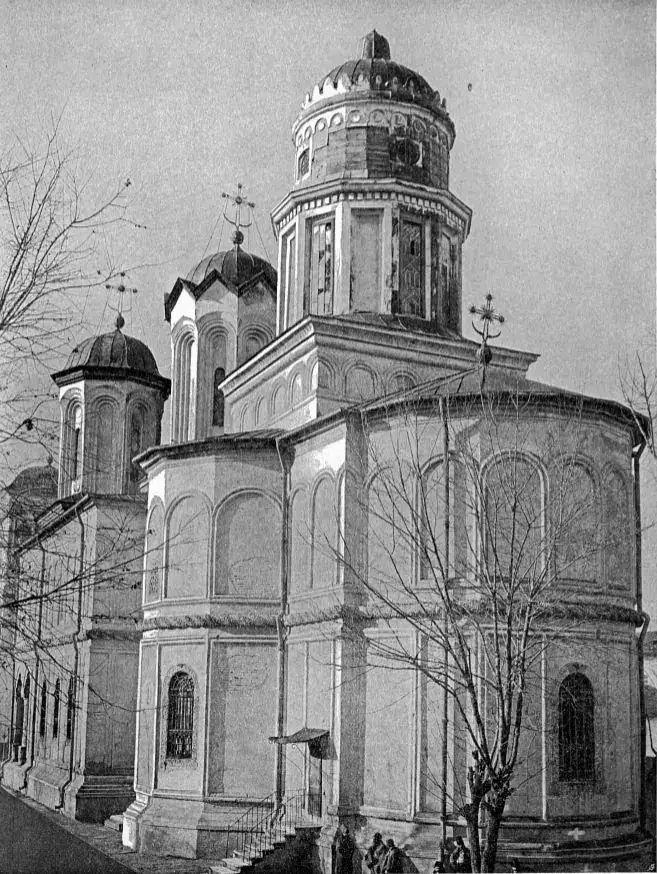
Communist Romania waged a forty-year campaign against religion. In 1948 it abolished an entire church — the Romanian Greek-Catholic Church — and arrested all its bishops, who were left to die in prison (Vatican News). It placed the remaining churches under state control, imprisoned priests and monks who would not submit, and in the 1980s bulldozed historic churches and monasteries to make way for Nicolae Ceaușescu’s building projects (Sighet Memorial).
Abolishing a church, 1948
The Romanian Greek-Catholic Church — Eastern in rite, in communion with Rome, and especially rooted in Transylvania — was the regime’s first great target. Decree 177 of 1948, the new law on religious denominations, cut its dioceses from five to two and provided for the transfer of its faithful and property to the Orthodox Church. That autumn the arrests of its clergy, monks and nuns began, and Decree 358 of 1 December 1948 declared the Church dissolved. Its parish properties were transferred to the Orthodox Church and the rest of its property to the state (Popescu, ECLJ).
On the night of 28 November 1948 all the Greek-Catholic bishops were arrested. They were imprisoned and left to die of hunger, exposure, disease or hard labour, and buried in unmarked graves (Vatican News):
| Bishop | Fate |
|---|---|
| Vasile Aftenie | Tortured at the Ministry of the Interior; died of his wounds in 1950 |
| Valeriu Traian Frențiu | Died in detention in 1952 |
| Ioan Bălan | Held in solitary confinement; died in 1959, never tried or sentenced |
| Alexandru Rusu | Sentenced to 25 years; died in 1963, buried in the prison cemetery without religious rites |
| Ioan Suciu | Died of hunger and disease in prison |
| Tit Liviu Chinezu | Ordained a bishop in prison; died of cold and hunger |
| Iuliu Hossu | Spent 22 years in detention |
On 2 June 2019, at Blaj in Transylvania, Pope Francis beatified all seven as martyrs (Vatican News).
The Church was legally recognized again after 1989, but recovering what had been taken proved slow. Decree-Law 126 of 1990 left property disputes to joint commissions with the Orthodox Church that in practice rarely reached any result, and Greek-Catholic parishes turned to the courts; in 2010 the European Court of Human Rights ruled in one such case that Romania had denied a parish access to a court (Popescu, ECLJ).
Priests and monks in prison
The regime also imprisoned Orthodox clergy and believers who would not conform. One circle of Orthodox monks and intellectuals, known as the Burning Bush (Rugul Aprins), was broken up when the Securitate arrested the sixteen people who made up the group (Ciornea).
The life of Gheorghe Calciu-Dumitreasa spans the whole communist era. A medical student in Bucharest, he was imprisoned in 1948 and sent for “re-education”, and was held until a general amnesty in 1964. He became an Orthodox priest and a teacher at the theological seminary in Bucharest, from which he was dismissed in 1978 for speaking out in defence of religious freedom and human rights. In 1979 he was arrested again and sentenced to ten years; severely mistreated and isolated even from his family, he was released early in 1984 after protests in the West, and emigrated to the United States in 1985 (Orthodox Church in America).
Bulldozing the churches
In the 1980s Ceaușescu’s vast building project in central Bucharest destroyed much of the city’s religious heritage. Monasteries and churches were demolished, some of them more than three centuries old, and others were moved and hidden away behind the new buildings. The most notorious demolition was that of the entire eighteenth-century Văcărești Monastery complex, shown at the top of this page; the site was earmarked for a new Palace of Justice that was never built (Sighet Memorial).
Why it matters
A communist party that claims to own the truth cannot tolerate institutions that answer to a higher authority. Romania’s regime abolished one church outright, let its bishops die in prison, bent another church to state control, imprisoned priests for decades for what they preached, and finally bulldozed the buildings themselves. The beatification of the Greek-Catholic bishops in 2019, seventy years after their arrest, is a reminder of how long it took for the truth about them to be honoured.
Further reading on this site
- The Securitate — the secret police behind the arrests.
- Chinese suppression of religion — another communist state’s war on faith.
- All articles on religion under communism and on Eastern Europe.
Sources
Scholarship
- Ciornea, Carmen. The Arrest and the Investigation of the Group 'Rugul Aprins' ('The Burning Bush'). Law, Society & Organisations 5, no. 8, 2019, pp. 49–57.
- Orthodox Church in America. In Memoriam: The Rev. George Calciu-Dumitreasa. oca.org, 21 November 2006, 2006.
- Pope Francis beatifies seven Greek-Catholic martyrs. Vatican News, 2 June 2019, 2019.
- Popescu, Andreea. The Properties of the Romanian Greek-Catholic Parishes. European Centre for Law and Justice, 2 June 2015, 2015. — Decrees 177 and 358 of 1948; property; Decree-Law 126/1990; European Court of Human Rights