Stalin's Deportations: The Forced Transfer of Whole Peoples
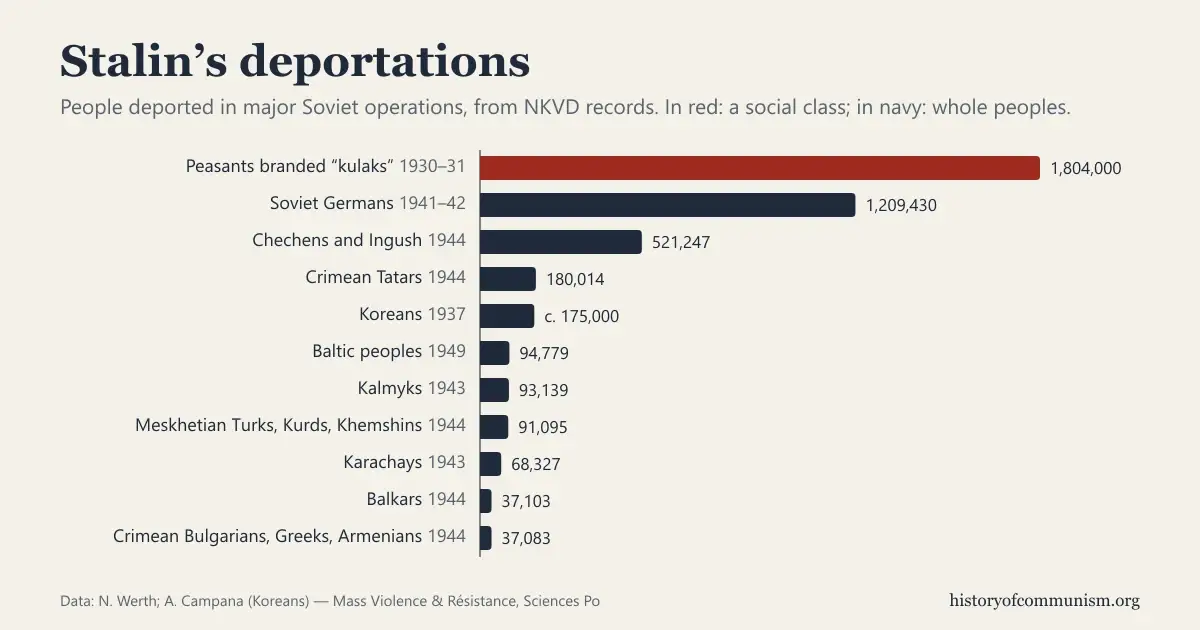
Under Stalin, the Soviet state forcibly resettled some six million people (Polian). It began with peasants branded “kulaks” — 1.8 million of them deported in 1930–31 alone — and went on to deport entire nations: Koreans, Soviet Germans, Chechens and Ingush, Crimean Tatars, Kalmyks, Karachays, Balkars, Meskhetian Turks and others, put on trains and sent to Central Asia and Siberia as collective punishment for crimes most of them had never committed (Werth). In 1991 Russia’s own parliament declared that a “policy of slander and genocide” had been carried out against these peoples at the state level.
The figures in this article are the NKVD’s own, as published by historians who have worked in the Soviet archives.
“Kulaks”: deportation by class
The first mass deportations were aimed at a social class. As Stalin forced the peasantry onto collective farms, the better-off farmers — or anyone the authorities chose to call a kulak — were expropriated and exiled. By the NKVD’s count, 1,804,000 people were deported in 1930–31 to remote “special settlements” (Werth).
Many did not survive. About 15 percent of those deported in the first wave of 1930 died in the months that followed. By January 1932 nearly half a million deportees were missing from the settlements — lost, in roughly equal numbers, to flight and to death. In 1933 alone, 151,000 special settlers died, 14 percent of the settlement population (Werth).
Clearing the borders, 1935–1941
In the mid-1930s the regime began deporting people for their nationality. It removed Finns from the Leningrad region in 1935; about 35,700 Poles from the Ukrainian border zone, and some 20,000 Finnish peasants, to Kazakhstan in 1936; and, in September–October 1937, about 175,000 Koreans from the Soviet Far East to Kazakhstan and Uzbekistan, where many died of disease, hunger and lack of housing (Campana). The historian Terry Martin has described these operations as the origins of Soviet ethnic cleansing (Martin).
After the Soviet Union annexed eastern Poland and the Baltic States, the deportations followed it west: about 250,000 Poles from the annexed Polish territories in 1940 (Campana), and in May–June 1941 an operation in the Baltic States, the newly annexed western regions and Moldavia in which 107,000 people were arrested and 86,000 deported (Werth).
The punished peoples, 1941–1944
During the war with Germany the regime deported entire nations on charges of disloyalty or collaboration. These are the NKVD’s figures (Werth), with historians’ estimates of mortality where they exist (Campana):
| People | Date | Deported | Estimated deaths |
|---|---|---|---|
| Soviet Germans | from August 1941 | 1,209,430 by March 1942 | No reliable data |
| Karachays | November 1943 | 68,327 | — |
| Kalmyks | December 1943 | 93,139 | Thousands |
| Chechens and Ingush | February 1944 | 521,247 | About 30 percent of Chechens, 1944–52 |
| Balkars | March 1944 | 37,103 | 20–40 percent, 1944–1956 |
| Crimean Tatars | May 1944 | 180,014 | 20–46 percent in transit or the first 18 months |
| Bulgarians, Greeks and Armenians of Crimea | June 1944 | 37,083 | — |
| Meskhetian Turks, Kurds and Khemshins | November 1944 | 91,095 | — |
The charge of collective treason did not fit the facts. German forces had occupied only the north-west of the Chechen-Ingush republic, for about twelve weeks, and many Chechen men served in the Red Army or with the partisans; Aurélie Campana calls the charge of massive collaboration “fallacious” (Campana, Chechens). The Meskhetians of southern Georgia were deported in November 1944, “at a time when no German presence threatened the Caucasus” — and they were never even accused of collaborating with the Germans (Tournon). The NKVD deported the Chechens and Ingush in eight days. Soviet officials themselves estimated that 14.6 to 23.7 percent of the deportees died in 1944–48, not counting deaths during the journey; a demographic study based on NKVD documents puts Chechen deaths at about 30 percent between 1944 and 1952 (Campana, Chechens). Their autonomous republic was abolished, as were those of other deported peoples.
The Baltic deportations after the war
Deportations from the Baltic States resumed after Soviet forces returned. Between 25 March and 10 May 1949, 94,779 people — 30,630 families — were deported from Lithuania, Latvia and Estonia (Werth), following some 48,000 in 1948 (Campana).
“A policy of slander and genocide”
On 26 April 1991, the Russian republic’s parliament passed a law “On the Rehabilitation of Repressed Peoples”. Its first article declared the repressive acts against these peoples “unlawful and criminal”. Its second defined the repressed peoples as those against whom “a policy of slander and genocide was carried out at the state level,” accompanied by forced resettlement, the abolition of their national territories and the establishment of a regime of terror and violence in the special settlements (Law of the RSFSR, 1991).
Historians have made the same argument: J. Otto Pohl titled his study of these deportations “Stalin’s Genocide against the ‘Repressed Peoples’” (Pohl).
Why it matters
The deportations show how the logic of class war became the logic of collective guilt. The regime began by treating a whole social class as an enemy to be uprooted, and ended by treating whole nations the same way — children, the elderly and Red Army soldiers’ families alike — on the basis of who they were, not what they had done. That is why a successor Russian parliament, with access to the same archives, chose the word genocide.
Further reading on this site
- The Holodomor — the famine that followed collectivization in Ukraine.
- North Korea’s political prison camps — collective punishment of families, still practised today.
- All articles on the Soviet Union and on repression.
Sources
Primary sources
Scholarship
- Campana, Aurélie. The Soviet Massive Deportations — A Chronology. Mass Violence & Résistance, Sciences Po, 5 November 2007, 2007. — Operations of 1935–1950 and estimated mortality
- Campana, Aurélie. The Massive Deportation of the Chechen People: How and why Chechens were Deported. Mass Violence & Résistance, Sciences Po, 2007.
- Martin, Terry. The Origins of Soviet Ethnic Cleansing. The Journal of Modern History 70, no. 4, 1998, pp. 813–861.
- Pohl, J. Otto. Stalin's Genocide against the 'Repressed Peoples'. Journal of Genocide Research 2, no. 2, 2000, pp. 267–293.
- Polian, Pavel. Against Their Will: The History and Geography of Forced Migrations in the USSR. Central European University Press, 2003.
- Tournon, Sophie. The Deportation of Muslims from Georgia. Mass Violence & Résistance, Sciences Po, 25 February 2009, 2009.
- Werth, Nicolas. Mass Crimes under Stalin (1930–1953). Mass Violence & Résistance, Sciences Po, 14 March 2008, 2008. — NKVD figures for dekulakization and the deportations of peoples, 1930–1949