North Korea's Political Prison Camps: The Hidden Gulag
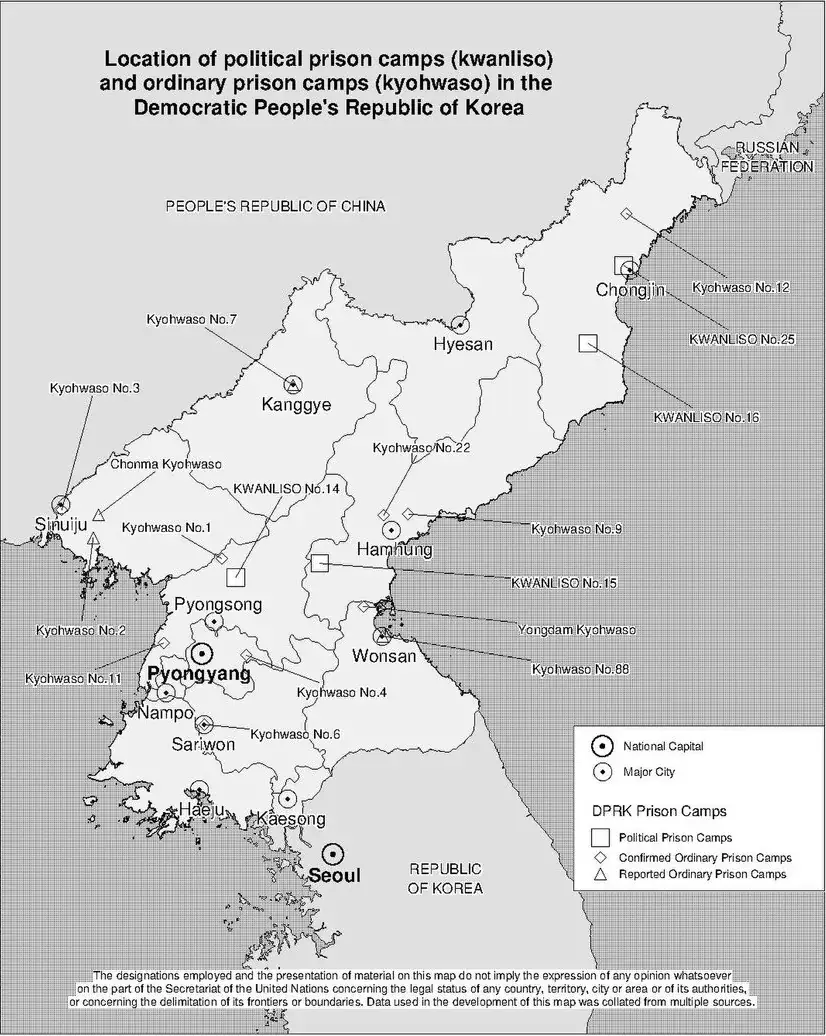
North Korea runs a system of political prison camps — kwanliso — into which people are made to disappear without trial. In 2014 a United Nations Commission of Inquiry concluded that in these camps “the inmate population has been gradually eliminated through deliberate starvation, forced labour, executions, torture, rape and the denial of reproductive rights enforced through punishment, forced abortion and infanticide,” and estimated that hundreds of thousands of political prisoners have perished in them over five decades (UN Commission of Inquiry, para. 60). The camps are still operating.
This article is based chiefly on the Commission’s report, which drew on the public testimony of more than 80 witnesses and experts, and on the accounts of survivors.
“Disappeared” without trial
North Korea has two kinds of camp. The kwanliso are political prison camps; the kyohwaso are ordinary prison camps, where gross violations are also committed (UN Commission, paras. 59, 62).
People found to have committed what the regime considers major political crimes are “disappeared”, without trial or judicial order, into the kwanliso. They are held incommunicado, and their families are not even informed if they die. For decades the authorities also sent entire families to the camps for a political crime committed by one relative — including relatives up to the third generation — under the principle of guilt by association. The Commission found that such cases still occur, though less often than in past decades (para. 59).
Life and death in the camps
The Commission’s description of the kwanliso is among the starkest findings in any UN report. The inmate population, it found, “has been gradually eliminated” through:
- deliberate starvation;
- forced labour;
- executions;
- torture;
- rape;
- and the denial of reproductive rights, enforced through punishment, forced abortion and infanticide.
“The unspeakable atrocities that are being committed against inmates of the kwanliso political prison camps,” the Commission wrote, “resemble the horrors of camps that totalitarian States established during the twentieth century” (para. 60).
How many
The Commission estimated that hundreds of thousands of political prisoners have died in the camps over the past five decades. North Korea denies that the camps exist; the Commission found that denial disproved by the testimony of former guards, inmates and neighbours, and by satellite imagery showing that the system continues to operate. As deaths and some releases reduced their number, it estimated that between 80,000 and 120,000 political prisoners were held in four large camps in 2014 (paras. 60–61). The map at the top of this page, published with the Commission’s report, shows their locations: Kwanliso Nos. 14, 15, 16 and 25.
The camps today
Because no independent observer can visit, much of what is known about the camps now comes from satellite imagery. The Committee for Human Rights in North Korea, a research organization, continues to publish imagery analyses: of Camp 14 (2021), of Camp 15 and Camp 25 (2024), and, in June 2024, its first report on Kwanliso No. 18 at Pukch’ang (HRNK).
Survivors’ testimony

Kang Chol-hwan, a survivor of the Yodok camp, meets President George W. Bush in the Oval Office, 13 June 2005. Photo: White House Photo Office, U.S. National Archives. Public domain. Source.

Kang Chol-hwan was nine years old when, in 1977, his family was sent without trial to the Yodok camp — apparently because his grandfather was suspected of counter-revolutionary views. The family had lived in Japan before moving to North Korea. Kang was released in 1987, later escaped, and with Pierre Rigoulot wrote The Aquariums of Pyongyang (2001), one of the first accounts by a survivor of the camps. The only lesson his imprisonment had “pounded into me,” he wrote, “was about man’s limitless capacity to be vicious” (Publishers Weekly).
Shin Dong-hyuk became the best-known camp survivor through Blaine Harden’s book Escape from Camp 14 (2012). In 2015 Shin admitted that he had changed important details: he now says he was moved to the less strictly guarded Camp 18 at the age of six, that he had escaped to China earlier and been recaptured and returned to Camp 14, and that the torture he described took place when he was 21, not 13. Harden wrote in a new foreword that Shin was “now determined to tell the truth,” adding: “Regrettably, he has told me this before. It seems prudent to expect more revisions” (MPR News).
Shin’s case shows why individual testimony about North Korea must be weighed with care — and why the UN Commission’s findings, which rest on the consistent evidence of many witnesses, satellite imagery and documents rather than on any single account, carry such weight.
Crimes against humanity
The Commission concluded that crimes against humanity have been committed in North Korea “pursuant to policies established at the highest level of the State.” Among them it listed extermination, murder, enslavement, torture, imprisonment, rape, forced abortions and other sexual violence, persecution, the forcible transfer of populations, enforced disappearance and “the inhumane act of knowingly causing prolonged starvation” — and it found these crimes ongoing, because the policies and institutions behind them remain in place (paras. 75–76).
Its overall verdict was unequivocal: “The gravity, scale and nature of these violations reveal a State that does not have any parallel in the contemporary world.” The Commission went on to describe North Korea as a totalitarian State, one that “seeks to dominate every aspect of its citizens’ lives and terrorizes them from within” (paras. 80–81). It recommended that the UN Security Council refer the situation to the International Criminal Court (para. 94).
Why it matters
Most of the camps described on this site belong to history. North Korea’s do not. The system the UN Commission documented — disappearance without trial, collective punishment of families, deliberate starvation and forced labour unto death — is the system of the Soviet Gulag, still running in the twenty-first century, in a state that still calls itself socialist. The Commission’s report is the clearest modern statement of what a communist dictatorship becomes when nothing restrains it.
Further reading on this site
- North Korean information control — how the regime cuts its people off from the outside world.
- North Korean property control — the state’s ownership of everything.
- The Stasi — another communist state’s apparatus of surveillance and punishment.
- All articles on North Korea and on repression.
Sources
Primary sources
- Kang Chol-hwan; Rigoulot, Pierre. The Aquariums of Pyongyang: Ten Years in the North Korean Gulag. Basic Books, 2001.
- United Nations Human Rights Council, Commission of Inquiry (Kirby, Michael; Biserko, Sonja; Darusman, Marzuki). Report of the commission of inquiry on human rights in the Democratic People's Republic of Korea (A/HRC/25/63). United Nations, 7 February 2014, 2014. — Paragraphs 59–61 (political prison camps), 75–76 (crimes against humanity), 80–81 (totalitarian State), 94 (ICC referral)
Scholarship
- Harden, Blaine. Escape from Camp 14: One Man's Remarkable Odyssey from North Korea to Freedom in the West. Viking, 2012.
Reference works
- Committee for Human Rights in North Korea (HRNK). Political Prison Camps (reports archive). HRNK, 2024. — Satellite-imagery reports on Camps 14, 15, 25 and 18, 2021–2024
- Mumford, Tracy. North Korea's most famous defector changes his story. MPR News, 26 February 2015, 2015.
- Review: The Aquariums of Pyongyang. Publishers Weekly.