Vyacheslav Molotov and the Origin of the Molotov Cocktail
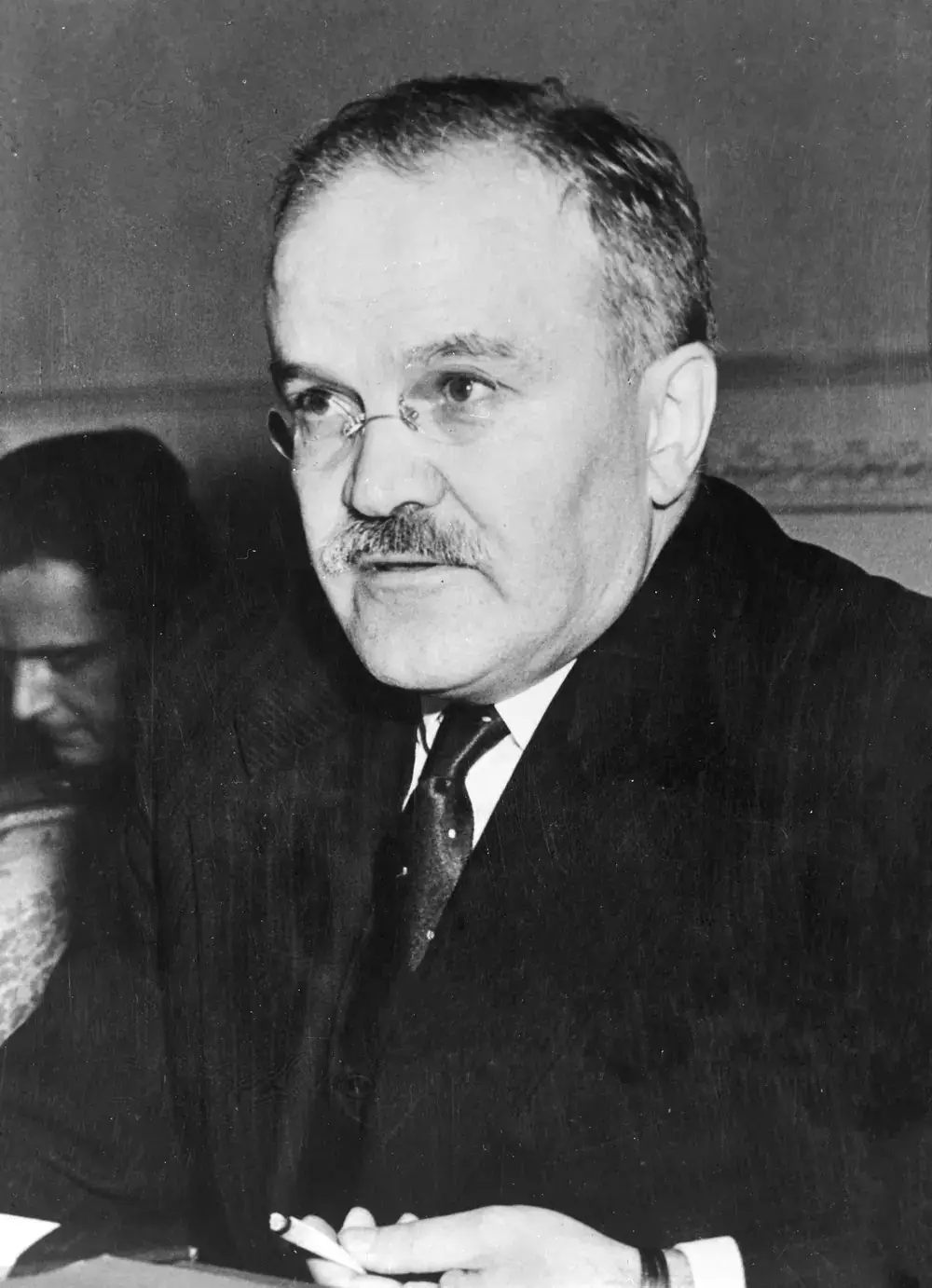
Vyacheslav Mikhailovich Molotov (1890–1986) was Stalin’s closest collaborator for three decades: head of the Soviet government during collectivization and the Great Terror, and the foreign minister who signed the 1939 pact with Hitler. Today his name is best known from a weapon. During the Soviet invasion of Finland in 1939–40, Finnish soldiers turned “Molotov” into a stock joke for everything the enemy threw at them, and called their own improvised incendiary grenades “Molotov’s cocktails.” The mockery is well documented. Some of the story usually told with it, that Molotov claimed Soviet bombers were dropping bread, is not.
From Skryabin to “the hammer”
He was born Vyacheslav Skryabin in 1890 in Kukarka, in Vyatka province, and joined the Bolsheviks in 1906 (Encyclopedia of World Biography). Around 1912 he took the party name Molotov, from molot, “hammer,” and helped produce the first issues of Pravda. He was prominent in the first weeks of the February Revolution of 1917 but was not among the leaders of the October seizure of power. In 1921 he became a secretary of the Central Committee, just before Stalin was made General Secretary; he became a full member of the Politburo in 1926, and from December 1930 to May 1941 he chaired the Council of People’s Commissars, the Soviet government (Watson).
Collectivization and famine
Derek Watson, the historian of Molotov’s government, calls him “Stalin’s chief agent in agricultural policy, particularly collectivization” (Watson). In 1932, as hunger spread in Ukraine, Molotov told a party meeting that even facing “the specter of famine,” the grain plans “must be fulfilled at all costs.” On 21 June he and Stalin telegraphed Ukraine’s leaders that “no decrease in deliveries” would be tolerated. That autumn he led one of two Politburo commissions sent to enforce grain collection; when the party chief of Dnipropetrovsk region objected that his demands were economically irrational, Molotov replied that his position was “profoundly incorrect, non-Bolshevik” (Werth). The famine that followed is described in our article on the Holodomor.
The Terror’s most frequent signature
During the Great Terror of 1937–38, the NKVD sent the Politburo lists of party, state and military figures whose sentences, usually death, had been decided before trial. Memorial’s study of the 383 surviving lists, covering about 43,600 people, found that Molotov signed more of them than anyone else (Raczyński):
| Politburo member | Lists signed (1936–38) |
|---|---|
| Vyacheslav Molotov | 372 |
| Joseph Stalin | 357 |
| Lazar Kaganovich | 188 |
| Kliment Voroshilov | 185 |
| Andrei Zhdanov | 176 |
His signature also appears on mass operations far beyond the elite. With Stalin he approved an extra execution quota of 6,600 for Krasnoyarsk province, and on 21 August 1937 he and Stalin signed the decree ordering the deportation of all Koreans from the Soviet Far East (Jansen and Petrov, pp. 91, 100; see also Stalin’s deportations).
He never recanted. Interviewed in old age by the writer Feliks Chuev, Molotov maintained that “1937 was necessary” and that “one or two out of ten were wrongly caught, but the rest rightly” (Jansen and Petrov, pp. 105–106).
The pact with Hitler
In May 1939 Molotov became People’s Commissar for Foreign Affairs as well as head of government (Watson). On 23 August 1939 he and Joachim von Ribbentrop signed the Nazi-Soviet non-aggression pact. Its secret additional protocol divided Eastern Europe into spheres of influence: Poland was split along the Narew, Vistula and San rivers, and Finland, Estonia and Latvia were placed in the Soviet sphere (Secret Additional Protocol). Within weeks Germany and the Soviet Union had invaded Poland, and in 1940 the Baltic states were annexed (Seventeen Moments).
On 5 March 1940 Molotov was among the Politburo members who approved Lavrentii Beria’s proposal to shoot the Polish officers and other prisoners held by the NKVD, the decision behind the Katyn massacre (Katyn Museum).
The Winter War
Finland was the one country in the Soviet sphere that refused Moscow’s demands for territory. On 26 November 1939 Soviet artillery fire near the border village of Mainila was blamed on Finland; Finland’s Museo Militaria describes the shots as staged by the Soviet side to provide a pretext. On 28 November the Soviet government renounced its non-aggression pact with Finland (Museo Militaria). On 29 November Molotov spoke on Moscow radio of “revolting provocations, not stopping short of artillery fire upon our troops,” and assured listeners that the Soviet Union regarded Finland “whatever regime prevails there, as an independent sovereign State” (Molotov, 29 November 1939).
The Red Army attacked the next day, 30 November, without a declaration of war (Finnish Military Museum). On 2 December Molotov signed a “pact of mutual assistance and friendship” with a “Finnish Democratic Republic” headed by the Finnish communist Otto Kuusinen. Under its terms this rival “government” ceded the Karelian Isthmus to the Soviet Union and leased it the Hanko peninsula for thirty years as a naval base (Steinhardt, 3 December 1939). In December the League of Nations expelled the Soviet Union (Seventeen Moments).
| The Winter War, 30 November 1939 – 13 March 1940 | |
|---|---|
| Finnish dead | over 25,000 |
| Soviet troop losses | “in excess of 100,000” |
| Finnish territory ceded | about 12% |
| Finns evacuated from ceded areas | about 420,000 |
Sources: Finnish Military Museum (Finnish dead, territory, evacuees); Seventeen Moments (Soviet losses). Estimates of Soviet dead vary widely between Soviet-era, Russian and Finnish studies.
How Molotov’s name ended up on a bottle
Finnish soldiers answered the invasion with ridicule, and Molotov, the face of Soviet foreign policy, became its target. Simo Hämäläinen, a Finnish linguist who served in the war and collected soldiers’ slang, recorded about twenty expressions built on his name (Landau). The name also lent itself to puns: in Finnish, molottaa means “to gibber” (Landau).
| Finnish soldiers’ term | Literal meaning | Used for |
|---|---|---|
| Molotovin leipä | Molotov’s bread | a Soviet air bomb |
| Molotovin muna | Molotov’s egg | an air bomb |
| Molotovin varikset | Molotov’s crows | Soviet aircraft |
| Molotovin suljettu | Molotov’s drill | running for cover in an air raid (in print 9 December 1939) |
| Molotovin savotta | Molotov’s logging site | the war itself (in print 20 December 1939) |
| molotovoida | to “molotov” | to destroy with incendiary bottles and grenades (in print 3 February 1940) |
| Molotovin koktaili | Molotov’s cocktail | the incendiary bottle used against tanks |
Source: Hämäläinen’s Suomalainen sotilasslangi (1963), as cited by Landau.
The clearest contemporary witness is Walter Citrine, a British trade-union leader who visited Finland with a Labour delegation in January 1940. In the diary he published that spring, he noted that the Finns spoke of “Molotov’s bombs” and called the crude hand grenades they used against Russian tanks “Molotov’s cocktails.” Stalin, he was told, was not mentioned, because people blamed the turn in Soviet policy on Molotov’s arrival as foreign minister (Landau).
What the record does and does not show
- The Finnish origin is well supported. The many “Molotov” terms in Finnish soldiers’ slang, and the possessive form “Molotov’s cocktails” in Citrine’s diary, point to a Finnish expression translated into English (Landau).
- English printed it first. The earliest printed uses found so far are British: Citrine’s diary and British newspapers from February 1940. The earliest Finnish printed example Hämäläinen found is from August 1941. Hämäläinen himself suspected that foreign correspondents coined the English phrase. The Oxford English Dictionary notes that the English evidence is earlier but judges Finnish influence “likely”; the researcher David Landau, who searched Finnish, Swedish and British newspapers, concludes that the source is Finnish (Landau).
- The “bread” broadcast is unconfirmed. A popular version holds that Molotov claimed on the radio that Soviet planes were dropping food, not bombs, on the Finns, who then offered “a drink to go with the food.” His radio address of 29 November 1939 contains nothing of the kind, Landau’s study of the term does not mention such a claim, and we have found no contemporary record of it. Until one turns up, it is best treated as legend; the soldiers’ “Molotov’s bread” for bombs is documented, the broadcast behind it is not.
The phrase outlived the war largely because Britain adopted it in the summer of 1940, when improvised anti-tank weapons were prepared against a feared German invasion (Landau).
War, the Cold War and disgrace
In May 1941 Stalin took over as head of government, and Molotov became his deputy. During the war he was deputy chairman of the State Defense Committee, responsible for tank production, while remaining foreign minister; he negotiated the 1942 alliance with Britain and the United States and represented the Soviet Union at the wartime conferences and at the founding of the United Nations in San Francisco in 1945. He earned a reputation in the West as a blunt opponent of Western policy (Watson).
Loyalty did not protect him. In 1949 Stalin dismissed him as foreign minister, and his wife, Polina Zhemchuzhina, was imprisoned from 1949 until 1953; Molotov later admitted that he had voted in the Politburo for her arrest (Watson).
After Stalin’s death in 1953 Molotov returned as foreign minister. He lost the post again in 1956, and in June 1957 Molotov joined Kaganovich and other Stalinist veterans in a failed attempt to depose Khrushchev (Seventeen Moments; see our biography of Khrushchev). Branded leader of an “anti-Party group,” he was sent as ambassador to Mongolia and then, in 1960–61, served as the Soviet representative on international atomic energy matters. He was expelled from the party in 1962, readmitted in 1984 (Watson), and died in Moscow on 8 November 1986, aged 96 (Encyclopedia of World Biography).
The man and the name
Molotov lived to 96 and, as far as the record shows, defended the Terror to the end. In 1939–40 his name became a soldiers’ joke because, to the Finns, he was the voice of the invasion: the minister who announced it as a response to “provocations” and signed a treaty with a rival Finnish “government” two days after it began. The joke has outlasted most of what he built. The documents behind it are another matter: the execution lists, the famine telegrams, the protocol with Hitler and the Katyn decision all carry his signature.
Further reading on this site
- Joseph Stalin: a short biography and Nikita Khrushchev: a short biography.
- The Holodomor — the Ukrainian famine of 1932–33.
- Stalin’s deportations and repression under communism.
- Communist leaders: a reference list and the Cold War hub.
Sources
Primary sources
- Molotov, V. M. War with Finland: radio address by V. M. Molotov, 29 November 1939. Seventeen Moments in Soviet History (University of Illinois), from League of Nations, Official Journal, Part II (30 November 1939), p. 541, 1939.
- Ribbentrop, Joachim von; Molotov, V. M. Secret Additional Protocol to the Treaty of Nonaggression between Germany and the Union of Soviet Socialist Republics (23 August 1939). The Avalon Project, Yale Law School (from Nazi-Soviet Relations 1939–1941, U.S. Department of State, 1948), 1939.
- Steinhardt, Laurence A. Telegram from the Ambassador in the Soviet Union (Steinhardt) to the Secretary of State, Moscow, 3 December 1939. Foreign Relations of the United States, 1939, General, Volume I, Document 1129 (Office of the Historian), 1939. — Molotov's pact with Kuusinen's 'Finnish Democratic Republic'
Scholarship
- Jansen, Marc; Petrov, Nikita. Stalin's Loyal Executioner: People's Commissar Nikolai Ezhov, 1895–1940 (chapter 4, The Great Terror). Hoover Institution Press, 2002, pp. 91, 100, 105–106. — Molotov's quota approvals; the Korean deportation decree; his later defense of 1937 (citing Chuev, Molotov Remembers)
- Katyn Museum (Muzeum Katyńskie). Perpetrators of the crime. Muzeum Katyńskie, Warsaw. — Signatories of the Politburo decision of 5 March 1940
- Landau, David. The Source of the Term Molotov Cocktail. Tampere (self-published research paper, drawing on S. Hämäläinen, Suomalainen sotilasslangi, 1963, and the Finnish War Archive). — Finnish soldiers' Molotov slang; Citrine's January 1940 diary entry; earliest English (1940) and Finnish (1941) printed uses; the OED's view
- Raczyński, Jan. Stalin's execution lists in the system of Soviet state terror. Sybir Memorial Museum (Muzeum Pamięci Sybiru), Białystok, 2024. — By the chairman of Memorial; counts of lists signed by each Politburo member
- Siegelbaum, Lewis. Seventeen Moments in Soviet History: subject essays on Soviet Territorial Annexations and the Anti-Party Group. Seventeen Moments in Soviet History (University of Illinois).
- Werth, Nicolas. The Great Ukrainian Famine of 1932–33. Mass Violence & Résistance, Sciences Po, 18 April 2008, 2008.
Reference works
- Finnish Military Museum. The Winter War. talvisota.fi (Sotamuseo / Winter War Association). — Finnish casualties, territory ceded, evacuees
- Molotov, Vyacheslav Mikhailovich (Encyclopedia of World Biography entry). Gale, via Encyclopedia.com. — Birth in 1890, party membership 1906, death on 8 November 1986
- Museo Militaria. Leading up to Winter War. Museo Militaria (Hämeenlinna). — Mainila shots; termination of the non-aggression pact
- Watson, Derek. Molotov, Vyacheslav Mikhailovich. Encyclopedia of Russian History (Macmillan Reference USA), via Encyclopedia.com, 2004. — Career outline by the author of Molotov and Soviet Government (1996)