Mao Zedong: A Short Biography
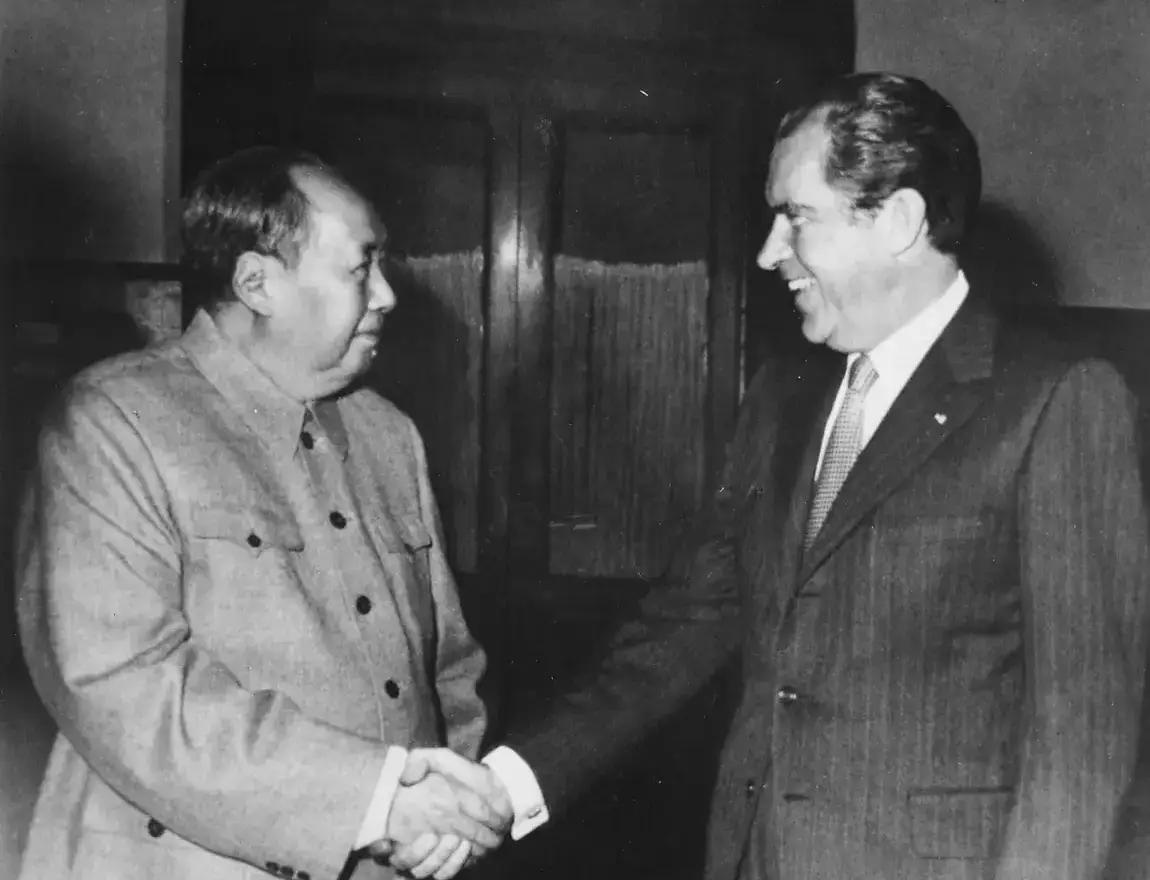
Mao Zedong (1893–1976) led the Chinese Communist Party to power in 1949 and ruled the People’s Republic of China until his death. He presided over campaigns of terror, the largest famine in modern history and a decade of upheaval he himself unleashed. He is the leading figure of Chinese communism in our list of communist leaders; for his ideas, see Mao Zedong Thought.
A rebel from Hunan
Mao was born on 26 December 1893 in the village of Shaoshan in Hunan province (Wikidata), the son of a former peasant who had prospered as a farmer and grain dealer. At 13 he was put to work full-time on the family farm; rebelling against his father, he refused to acknowledge an arranged marriage and left home to study. He served six months as a soldier in the revolution of 1911, graduated from the provincial normal school in Changsha in 1918, and then worked as a librarian’s assistant at Peking University, where he came under the influence of Li Dazhao and Chen Duxiu, soon to found the Chinese Communist Party. “The world is ours, the nation is ours, society is ours,” he wrote in 1919 (Schram, Britannica). The party was founded in 1921 (Britannica).
Power from the barrel of a gun
Mao built his revolution on the peasantry and on force. “A revolution is not a dinner party,” he wrote in 1927; “a revolution is an insurrection, an act of violence by which one class overthrows another” (Mao, 1927). In 1938 he told the party: “Every Communist must grasp the truth, ‘Political power grows out of the barrel of a gun’” (Mao, 1938).
When Nationalist offensives drove the Communists from their bases in 1934, the Red Army, reduced from 300,000 men to about 30,000 by the party’s own count, set out on the Long March. A Politburo meeting at Zunyi in January 1935 “established the leading position of Comrade Mao Zedong” (CCP Resolution, 1981). At the party’s wartime base, Yan’an, Mao secured his dominance through the Rectification Movement of 1942–45 — in the historian Gao Hua’s account, “a politics of terror” in which torture and violence forced party members into false confessions (Sempa, review of Gao Hua).
Terror in power
Having won the civil war, Mao became head of the new People’s Republic in 1949 (Britannica). Its first great campaign, in 1950–53, targeted “counter-revolutionaries.” The historian Yang Kuisong opens his study of it with a principle: “Power seized with violence has to be maintained with violence” (Yang, 2008). By the end of 1953 over 712,000 people had been officially executed — 0.124 percent of the population, exceeding the target of 0.1 percent that Mao himself had set (China Change, summarizing Yang).
In 1957 Mao invited intellectuals to criticize the party — “let a hundred flowers blossom” — and then turned on those who did. About 550,000 people were branded “rightists” (Kotobank). Mao answered the charge that it had been a trap: “Some people say this was a covert scheme. We say it was an overt one” (Mao, 1957). See the Hundred Flowers Campaign.
The Great Leap Forward
In 1958 Mao launched the Great Leap Forward, forcing peasants into vast communes and demanding impossible harvests. Even the party’s own verdict concedes that “Comrade Mao Zedong and many leading comrades” had “become smug,” were “impatient for quick results” and “overestimated the role of man’s subjective will” (Resolution, para. 17). At the Lushan conference in 1959 Mao turned on Peng Dehuai and launched a party-wide struggle against “Right opportunism,” which, the party later admitted, cut short the correction of the Leap’s errors (Resolution). The famine that followed killed “almost 30 million” according to demographers (Ashton et al., 1984), 36 million according to Yang Jisheng and 45 million according to Frank Dikötter (Johnson, NYRB). See the Great Chinese Famine.
The Cultural Revolution
In 1966 Mao struck at his own party. The Cultural Revolution, “initiated and led by Comrade Mao Zedong,” was by the party’s own judgment “responsible for the most severe setback and the heaviest losses suffered by the Party, the state and the people since the founding of the People’s Republic” (Resolution, para. 19). In rural China alone it killed between 750,000 and 1.5 million people and subjected 36 million to political persecution (Walder and Su, 2003). Mao became the object of mass worship; the army imposed “mandatory rituals of worship such as daily reading of the Little Red Book” (Leese, Mao Cult).
Wives and family
Mao married four times. He married Yang Kaihui in 1920; she was later killed during the civil war. His third wife, He Zizhen, made the Long March while pregnant; in 1939 he divorced her and married the film actress Jiang Qing (Britannica), who wielded great power during the Cultural Revolution and was later denounced as head of the “Gang of Four” (Resolution, paras. 21–22).
Death and verdict
Mao died in Beijing on 9 September 1976 (Wikidata). Within weeks Jiang Qing and her allies, the Gang of Four, had been overthrown (Resolution, para. 22). In 1981 the party gave its verdict. It placed “chief responsibility” for the Cultural Revolution on Mao — and still ruled that “his merits are primary and his errors secondary” (Resolution, paras. 22, 27). It gave no figure for the dead of the famine or the Cultural Revolution.
Why it matters
Mao’s China shows the pattern of communist rule at its most extreme: a party that took power by force, kept it by terror, and pursued utopian plans regardless of the human cost — then, after his death, protected its legitimacy by excusing him. His Thought remains in the party’s constitution (CCP Constitution, 2022).
Further reading on this site
- Mao Zedong Thought — the ideology, in Mao’s own words.
- The Great Chinese Famine and the Hundred Flowers Campaign.
- Joseph Stalin: a short biography and Vladimir Lenin: a short biography.
- Communist leaders: a reference list.
Sources
Primary sources
- Central Committee of the Chinese Communist Party. Resolution on Certain Questions in the History of Our Party since the Founding of the People's Republic of China (27 June 1981). Marxists Internet Archive, 1981.
- Communist Party of China. Constitution of the Communist Party of China (revised 22 October 2022). Qiushi (English edition), via China Daily, 2022.
- Mao Zedong. Report on an Investigation of the Peasant Movement in Hunan (March 1927). Selected Works, vol. 1 (Marxists Internet Archive), 1927.
- Mao Zedong. Problems of War and Strategy (6 November 1938). Selected Works, vol. 2 (Marxists Internet Archive), 1938.
- Mao Zedong. Wen Hui Pao's Bourgeois Orientation Should Be Criticized (People's Daily editorial, 1 July 1957). Selected Works, vol. 5 (Marxists Internet Archive), 1957.
Scholarship
- Ashton, Basil; Hill, Kenneth; Piazza, Alan; Zeitz, Robin. Famine in China, 1958–61. Population and Development Review 10, no. 4, 1984, pp. 613–645.
- China Change. Reconsidering the campaign to suppress counterrevolutionaries (summary of Yang Kuisong). China Change, 28 November 2011, 2011.
- Johnson, Ian. China: Worse Than You Ever Imagined (review of Yang Jisheng, Tombstone, and Zhou Xun, The Great Famine in China). The New York Review of Books, 22 November 2012 (republished by ChinaFile), 2012.
- Leese, Daniel. Mao Cult: Rhetoric and Ritual in China's Cultural Revolution. Cambridge University Press, 2011.
- Sempa, Francis P. Review of Gao Hua, How the Red Sun Rose: The Origins and Development of the Yan'an Rectification Movement, 1930–1945. Asian Review of Books, 4 February 2019, 2019.
- Walder, Andrew G.; Su, Yang. The Cultural Revolution in the Countryside: Scope, Timing and Human Impact. The China Quarterly 173, 2003, pp. 74–99.
- Yang Kuisong. Reconsidering the Campaign to Suppress Counterrevolutionaries. The China Quarterly 193, 2008, pp. 102–121.
Reference works
- Britannica International Encyclopedia (Japanese); Obunsha World History Encyclopedia. 反右派闘争 (Anti-Rightist Struggle), encyclopedia entries. Kotobank.
- Editors of Encyclopaedia Britannica. What was Mao Zedong's family like? Encyclopaedia Britannica.
- Schram, Stuart Reynolds. Mao Zedong. Encyclopaedia Britannica. — Early years, education, May Fourth
- Wikidata. Mao Zedong (Q5816). Wikimedia Foundation. — Dates and places of birth and death; marriages